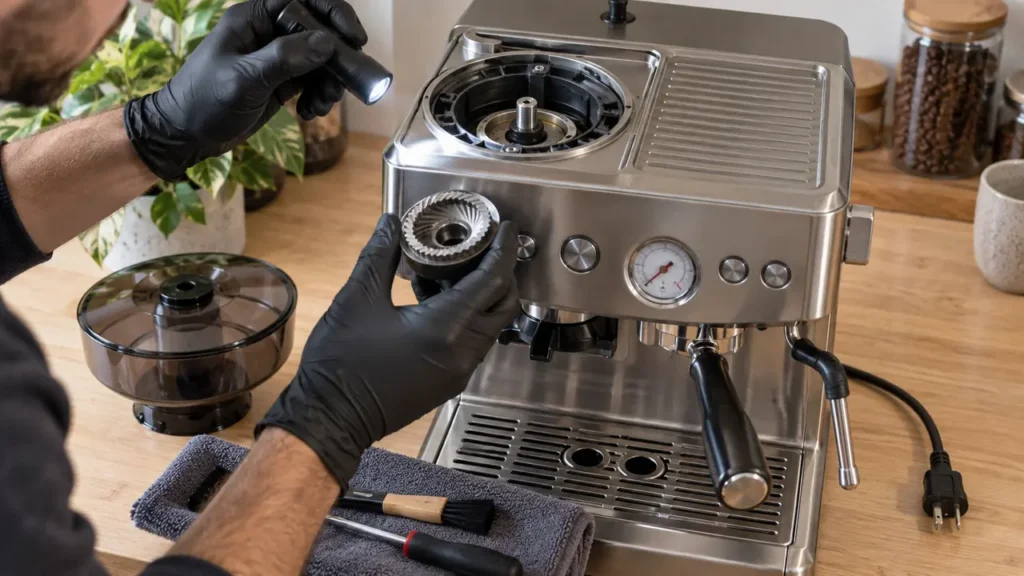
Most Breville Barista Express grinder faults are caused by a hopper interlock, compacted coffee, moisture, or an overheated grinder—not a failed motor. On the BES870, start with the symptom table below, clean the removable burrs and chute, and test again before buying parts. Stop at the service boundary if the grinder remains silent, smells hot, trips power, or has damaged wiring.
Safety first
Switch the machine off and unplug it before removing the hopper or touching the burrs. Let a hot machine cool. The burr edges are extremely sharp. Do not put fingers or tools into the grinder while it is connected to power. Breville directs owners to Consumer Support for maintenance beyond the cleaning procedures in the manual.
Quick diagnosis: match the grinder symptom
| Symptom | Most likely first check | Next action |
|---|---|---|
| FILTER SIZE lights flash | Bean hopper is not fully locked | Remove debris around the hopper seat, reinstall, and turn it firmly to LOCK |
| Motor runs, but no coffee comes out | Empty hopper, blocked chamber, blocked chute, or moisture | Empty the grinder, clean both burrs and the chute, then dry completely |
| Loud grinding, rattling, or clacking | Foreign object or compacted beans | Stop immediately; empty and inspect the grinder before another test |
| Machine stops during or after grinding | Thermal cut-out may have activated | Switch off, unplug, and cool for 30–60 minutes |
| Grinder is silent but the machine is on | Hopper interlock, grind-activation switch, or internal fault | Reseat the hopper and test the cradle once; if still silent, arrange service |
| Ground dose suddenly changes | Grind amount no longer matches the grind size | Re-dial the amount after cleaning and changing grind size |
If the motor can be heard but grounds do not reach the portafilter, go directly to standard burr cleaning. If the grinder is completely silent, complete the interlock and cool-down checks first. For a symptom-only checklist, see Breville Barista Express grinder not working.
Repairs an owner can safely try
- Correctly seat and lock the bean hopper.
- Empty stale or oily beans and run the grinder empty.
- Remove and brush the upper burr, lower burr surface, and grind chute.
- Clear a blockage using the advanced cleaning procedure in the BES870 manual.
- Dry a damp grinder chamber completely before reassembly.
- Adjust the external grind selector and, only when needed, the adjustable upper burr.
Internal motor, wiring, capacitor, thermal-protection, and control-board work is not an owner cleaning procedure. The Barista Express combines water, heat, mains voltage, and sharp rotating parts, so a grinder that remains electrically dead after basic checks should be diagnosed by Breville or a qualified appliance technician.
Before disassembly: five fast checks
- Confirm the exact model. This guide follows the U.S. BES870XL /A2 manual. Check the label under or behind your machine because regional Barista Express revisions can differ.
- Check for beans. An empty hopper can sound like a grinder problem even when the motor is operating normally.
- Lock the hopper. The BES870 flashes the FILTER SIZE LEDs when the hopper is not correctly attached. Remove it, clear loose grounds from the locking area, and reinstall it.
- Let the machine cool. If the machine stopped after repeated grinding or pumping, switch it off and unplug it for 30–60 minutes. Breville identifies the safety thermal cut-out as a possible cause.
- Listen once. A normal motor sound with no grounds points toward a blockage. A loud metallic sound suggests a foreign object. Silence after the interlock and cool-down checks suggests a service-level fault.
Standard Breville Barista Express grinder cleaning
Breville states that its normal conical-burr cleaning removes coffee-oil buildup that can impede performance. Use this first whenever output slows, clumps, or becomes inconsistent.
- Unlock and empty the hopper. Transfer usable beans to an airtight container.
- Reinstall and lock the empty hopper. This restores the safety interlock.
- Run the grinder until empty. Stop when no more coffee is delivered.
- Switch off and unplug. Never remove burrs with the machine connected to power.
- Remove the hopper. Turn it to UNLOCK and lift it away.
- Unlock the upper burr. Lift it out using its wire handle. Keep fingers away from the cutting edges.
- Brush the upper burr. Remove loose grounds and oily residue with the supplied cleaning brush.
- Brush the lower burr. Clean the exposed surface without forcing or bending components.
- Brush the grind chute. Clear compacted grounds from the outlet path.
- Reassemble. Seat the upper burr fully, turn it to LOCK, reinstall the hopper, and lock the hopper in place.
Keep the burr chamber dry
The BES870 troubleshooting table lists water or moisture in the grinder chamber and chute as a cause of no coffee output. Reassemble only when the burrs and chamber are thoroughly dry. Breville says air from a hair dryer may be used to help dry the chamber; use unheated or low-temperature airflow and keep the appliance unplugged.
Advanced blockage repair
Use the advanced procedure only when standard cleaning does not clear a blockage between the burrs and the grinder outlet. Photograph each layer before removal so the grind fan and washers return in the correct order.
Tools listed or shown by Breville
- The supplied cleaning brush
- A 10 mm socket
- Long-nose pliers
- A pipe cleaner for the grinds exit chute
- A clean tray for the nut, spring washer, flat washer, grind fan, metal washer, and felt washer
- Empty the grinder and unplug the machine. Remove the hopper only after the grinder has run empty.
- Set GRIND SIZE to 1. This is the finest external setting.
- Loosen the center nut. Use a 10 mm socket and rotate clockwise, following the direction shown in Breville’s manual.
- Move GRIND SIZE to 16. This is the coarsest external setting, then unlock and remove the upper burr.
- Remove the center parts in order. Lift out the nut, spring washer, flat washer, lower burr, and the grind-fan/washer stack. Keep their orientation and order.
- Clear the outlet. Brush the chamber and clean the grinds exit chute with the brush or a pipe cleaner. Remove only loose coffee or a visible foreign object; do not force the chute.
- Reinstall the stack exactly. Return the felt washer, metal washer, grind fan, lower burr, flat washer, spring washer, and nut in the order shown in the manual. Align the lower-burr drive pin and cavity.
- Tighten the nut counter-clockwise. Do not overtighten or substitute a different fastener.
- Lock the upper burr and hopper. Return the external selector to 5, reinstall the hopper, and lock it.
- Test with a small dose. Listen for a smooth sound and confirm that grounds reach the portafilter before filling the hopper.
When grind adjustment is the real fix
A grinder can be mechanically healthy but still produce shots that run too fast or too slowly. The BES870 has 16 external settings: smaller numbers are finer and larger numbers are coarser. Breville recommends starting at 5. If the external range cannot accommodate a particular coffee, the upper burr can be moved one numbered position at a time. Follow our Barista Express grinder settings guide before treating a calibration issue as a failed part.
Signs the grinder needs parts or professional service
- The grinder remains silent after the hopper is locked and the machine has cooled.
- The motor hums but cannot turn after the chamber is fully clear and dry.
- A burr is visibly chipped, cracked, badly corroded, or cannot lock into position.
- The grind-size selector will not move after loose coffee has been removed.
- There is a burning smell, smoke, sparking, repeated breaker trip, or melted plastic.
- The machine stops again immediately after the prescribed 30–60 minute cool-down.
- The activation switch or hopper interlock is physically broken.
Before ordering a burr, motor, gearbox, or control part, confirm the full model suffix and region. Parts that look identical may not be electrically or mechanically interchangeable. If the machine is under warranty, opening the case may affect coverage; use Breville’s warranty and repair channel first.
Post-repair test
- With the grinder empty, lock the hopper and power the machine on.
- Add only a small handful of fresh, dry beans.
- Set GRIND SIZE to 5 and GRIND AMOUNT near the 3 o’clock position.
- Select the correct FILTER SIZE and trigger one automatic dose.
- Stop immediately if the grinder clacks, stalls, smells hot, or fails to deliver grounds.
- If output is smooth, dial in the coffee one setting at a time rather than making a large jump.
Frequently asked questions
Why does the grinder run but no coffee comes out?
The BES870 manual lists an empty hopper, a blocked grinder chamber or chute, and moisture in the chamber as the main causes. Empty the grinder, complete standard cleaning, clear the chute if necessary, and reassemble only when everything is dry.
Why are both FILTER SIZE lights flashing?
The hopper is not correctly attached. Remove it, clear coffee from the locking area, reinstall it, and rotate it fully to LOCK.
Can I wash the Breville grinder burrs?
The grinder troubleshooting instructions emphasize that the burrs must be thoroughly dry before reassembly. For routine maintenance, use the supplied dry brush. Avoid introducing water into the grinder chamber.
Does a loud grinder mean the motor is failing?
Not necessarily. Breville lists a blockage or foreign object as the first cause of a loud grinder. Stop the grinder, unplug the machine, empty the hopper, and inspect and clean the chamber before another test.
Should I replace the burrs or the whole grinder?
Do not choose a part from the symptom alone. Clean and test first, then inspect for physical burr damage. A silent motor or repeated electrical shutdown needs service diagnosis because the burrs may not be the failed component.
Official references
- Breville BES870XL /A2 Barista Express instruction manual: conical-burr adjustment, cleaning, advanced cleaning, and troubleshooting
- Breville Barista Express product page: integrated conical-burr grinder and 16 grind settings
- Featured photo: Einar Faanes, “Zassenhaus coffee grinder hopper and burrs,” Wikimedia Commons, licensed under CC BY-SA 3.0. The photo illustrates burr components; it is not the BES870 grinder.

Last verified against Breville’s U.S. BES870 documentation: September 12, 2026.