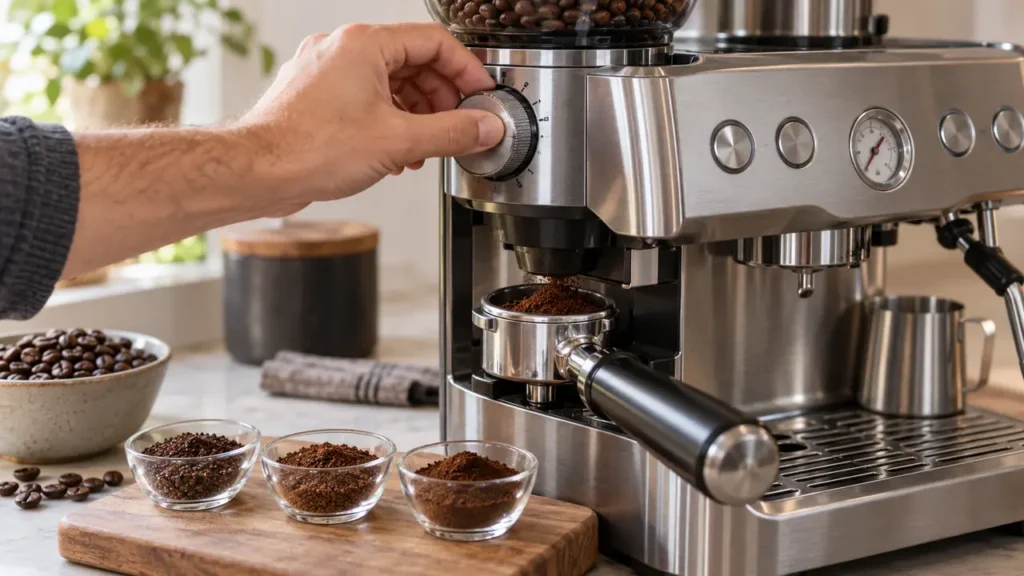
For the Breville Barista Express BES870, start with GRIND SIZE 5 and the GRIND AMOUNT dial at about 3 o’clock. Smaller grind numbers are finer; larger numbers are coarser. Pull one consistent test shot, then move only one setting at a time: go finer when the shot runs too fast and coarser when it drips or runs too slowly.
The short version
Use fresh beans, select the correct 1 CUP or 2 CUP filter size, keep dose and tamp consistent, and judge the result by flow, time, and taste together. The pressure gauge is useful, but it should not be the only target.
Breville Barista Express grinder settings at a glance
| Control or target | Starting point | What it changes |
|---|---|---|
| External GRIND SIZE | 5 | Particle size; lower numbers are finer, higher numbers are coarser |
| GRIND AMOUNT | 3 o’clock | How much ground coffee the automatic cycle dispenses |
| 1 CUP basket | About 8–10 g | Single-basket dose range in the BES870 manual |
| 2 CUP basket | About 15–18 g | Double-basket dose range in the BES870 manual |
| Balanced shot time | About 25–35 seconds | Breville’s extraction-guide range |
| Upper burr | Factory position; change only if needed | Extends the usable fine/coarse range |
Breville’s current U.S. product page describes the integrated grinder as having 16 external settings. This guide applies to the BES870XL /A2 manual; check your model label and regional instructions before copying settings from another Barista-series machine.
How to dial in the Barista Express
- Warm and prepare the machine. Use a clean, dry filter basket and a warmed group head and portafilter.
- Use fresh, dry beans. Changing the coffee changes the required setting, even when the roast color looks similar.
- Select the basket. Press FILTER SIZE for SINGLE with the 1 CUP basket or DOUBLE with the 2 CUP basket.
- Set the baseline. Turn GRIND SIZE to 5 and place GRIND AMOUNT near 3 o’clock.
- Grind and dose consistently. Distribute the grounds, tamp with the same technique each time, and use the Razor tool if the puck is above the intended level.
- Pull one test shot. Observe when flow begins, the total extraction time, color, body, and taste.
- Make one small change. If the shot is fast and pale, move one number finer. If it drips or tastes harsh, move one number coarser.
- Purge retained grounds. After changing size, grind a small amount so the next test reflects the new setting.
- Repeat. Keep dose and tamp stable until grind size is close, then use GRIND AMOUNT for the final dose correction.
What setting should you use for each result?
| Shot result | What you may see or taste | First grind change | Dose check |
|---|---|---|---|
| Under-extracted | Fast flow, thin pale crema, weak or sour cup; often under 20 seconds | Move one number finer | Increase only if the basket is under-filled |
| Balanced | Even flow, stable crema, rounded sweetness; roughly 25–35 seconds | Keep the setting | Keep the same dose and tamp |
| Over-extracted | Slow drips, dark spotty crema, bitter or astringent cup; often over 40 seconds | Move one number coarser | Reduce only if the basket is over-filled |
| No flow | Pump pressure rises but espresso does not emerge | Move coarser and verify the basket is not blocked | Remove excess grounds; do not force a choked shot |
Shot time is a diagnostic range, not a guarantee of flavor. A coffee that tastes balanced slightly outside the range may not need another change. Conversely, a shot inside the range can still need adjustment if it tastes sharply sour, hollow, dry, or bitter.
Grind size versus grind amount
GRIND SIZE controls resistance
Finer particles create more resistance to water and normally slow the shot. Coarser particles create less resistance and normally speed it up. The BES870 manual warns that coffee ground powdery-fine can prevent water from flowing through the puck.
GRIND AMOUNT controls the automatic dose
Breville recommends the 3 o’clock position as a baseline. After tamping, the metal cap on the supplied tamper should be level with the top edge of the filter-basket rim. Turn toward MORE when the basket is consistently under-filled and toward LESS when it is consistently over-filled.
FILTER SIZE changes the timed dose
The machine needs to know which basket you are using. Select SINGLE for the 1 CUP basket and DOUBLE for the 2 CUP basket. If the wrong option is selected, changing grind size alone will not correct the automatic dose.
A reliable one-variable dial-in method
- Keep the same beans, basket, dose target, distribution, tamp, and programmed shot volume.
- Change only GRIND SIZE until flow and time are close.
- Use one-number steps and record each result.
- Adjust GRIND AMOUNT only after the particle size is close.
- Taste every usable shot; do not chase the gauge at the expense of flavor.
- Recheck the dose whenever you change from the single basket to the double basket.
Why settings change over time
Coffee releases gas and behaves differently as it ages. Room humidity, roast level, bean density, and a new bag can all change flow. Needing a finer setting later in a bag does not automatically mean the grinder is failing.
When to adjust the upper burr
The adjustable upper burr extends the range when external setting 1 is still too coarse or setting 16 is still too fine. Do not use the upper burr as the first adjustment. Breville recommends moving it only one numbered position at a time and checking extraction again.
- Empty the hopper. Transfer beans to an airtight container, reinstall the hopper, and run the grinder until empty.
- Switch off and unplug. Unlock and remove the hopper.
- Remove the upper burr. Unlock it and lift it using the wire handle.
- Release the wire handle. Remove it from both sides of the adjustable burr collar.
- Move one number. Rotate the adjustable top burr one position finer or coarser, align the chosen number with the handle opening, and reinstall the handle.
- Reassemble. Push the upper burr firmly into position, lock it, reinstall and lock the hopper, then test at an external setting near the middle of the range.
If the upper burr will not lock, the selector is jammed, or the grinder makes a new metallic noise after adjustment, stop and recheck assembly. For cleaning, blockage, or mechanical diagnosis, use the Barista Express grinder repair guide. If the grinder is silent or dispenses no coffee, follow the grinder not working checklist.
Suggested starting directions by coffee
| Coffee or situation | Likely direction | Why |
|---|---|---|
| Fresh medium roast | Begin at 5 | Official BES870 starting point |
| Dark, oily roast | Often slightly coarser | Brittle beans and surface oils can increase fines and buildup |
| Dense light roast | Often finer | Denser coffee may need more resistance for espresso |
| Shot gets faster as a bag ages | Move finer one step | Older beans often offer less puck resistance |
| Switching to the 1 CUP basket | Recheck size and amount | Breville notes both may need adjustment when changing basket size |
| Using pre-ground coffee | Use a Dual Wall basket | The manual assigns Dual Wall baskets to pre-ground coffee |
These are directions, not universal numbers. Roast labels are broad, grinders have manufacturing tolerances, and the internal upper-burr position may differ. Your shot result is more useful than another owner’s exact dial number.
Common setting mistakes
- Changing grind size, dose, tamp, and shot volume at the same time.
- Selecting SINGLE while using the 2 CUP basket, or DOUBLE with the 1 CUP basket.
- Dialing by pressure-gauge position alone.
- Using old pre-ground coffee in a Single Wall basket.
- Ignoring an over-filled basket that touches the shower screen.
- Moving the upper burr several numbers at once.
- Assuming every new bag should use the previous bag’s setting.
- Continuing to dial in when the grinder is blocked, wet, or delivering an erratic dose.
Frequently asked questions
What is the best Breville Barista Express grind setting?
There is no universal best number. Breville recommends starting at 5 on the BES870, then adjusting for the specific beans, basket, dose, tamp, and shot result.
Which direction is finer on the Barista Express?
Lower numbers are finer. Higher numbers are coarser.
What dose should I use?
The BES870 manual lists approximately 8–10 g for the 1 CUP basket and 15–18 g for the 2 CUP basket. The current product page describes 18 g as the ideal dose for its 54 mm portafilter. Use the basket’s capacity and puck clearance as the final check.
Why does the correct setting change with new beans?
Different coffees vary in density, roast development, age, and moisture behavior. Re-dial whenever you change beans, and expect small adjustments as a bag ages.
What if setting 1 is still too coarse?
First verify dose, freshness, and grinder cleanliness. If those are correct, move the adjustable upper burr one number finer, reassemble, and test again.
Why is the grind-size dial hard to turn?
Compacted beans may load the burrs. Do not force the selector. Empty and clean the grinder, then inspect for a blockage. Use the repair guide if the dial remains jammed.
Official references
- Breville BES870XL /A2 Barista Express instruction manual: setting grind size and amount, extraction guide, basket dose, and upper-burr adjustment
- Breville Barista Express product page: 16 grind settings and 54 mm portafilter
- Featured photo: rohsstreetcafe, via Wikimedia Commons, licensed under CC BY-SA 2.0. The image is illustrative and does not show a BES870.

Last verified against Breville’s U.S. BES870 documentation: September 12, 2026.