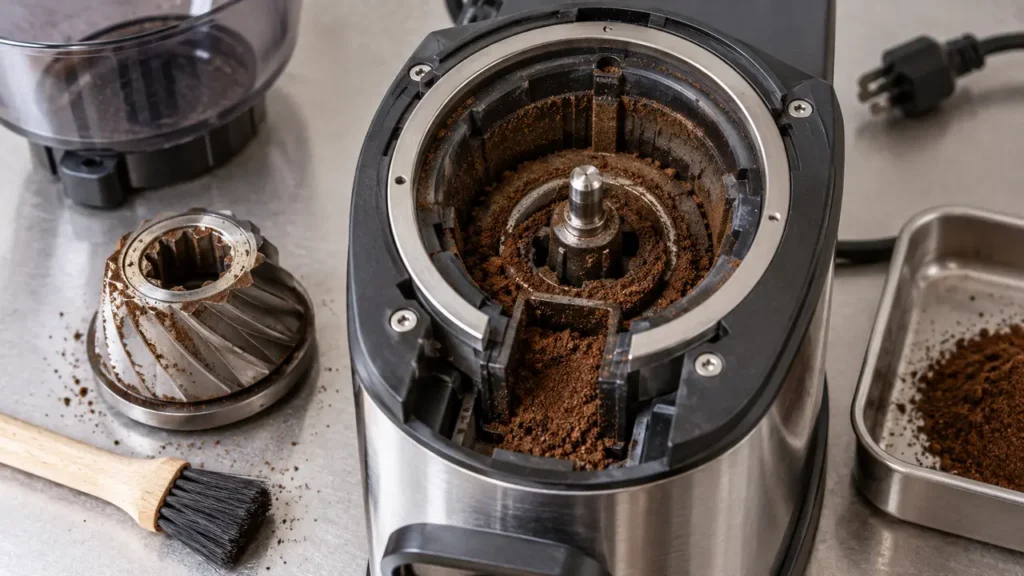
A jammed Breville Barista Express grinder is usually caused by compacted coffee in the burr chamber or exit chute, moisture, or a hopper that is not locked correctly. Switch the machine off and unplug it before removing beans or the upper burr. Clean dry parts with the supplied brush, keep water out of the grinder and reassemble every component securely before a short test.
Quick answer
- Turn off and unplug the Barista Express.
- Empty and remove the bean hopper.
- Unlock and lift out the upper burr.
- Brush loose grounds from the burr chamber and clear the exit chute.
- Make sure every grinder part is completely dry.
- Reinstall and lock the upper burr and hopper, then test with a small amount of beans.
Is the grinder jammed or electrically dead?
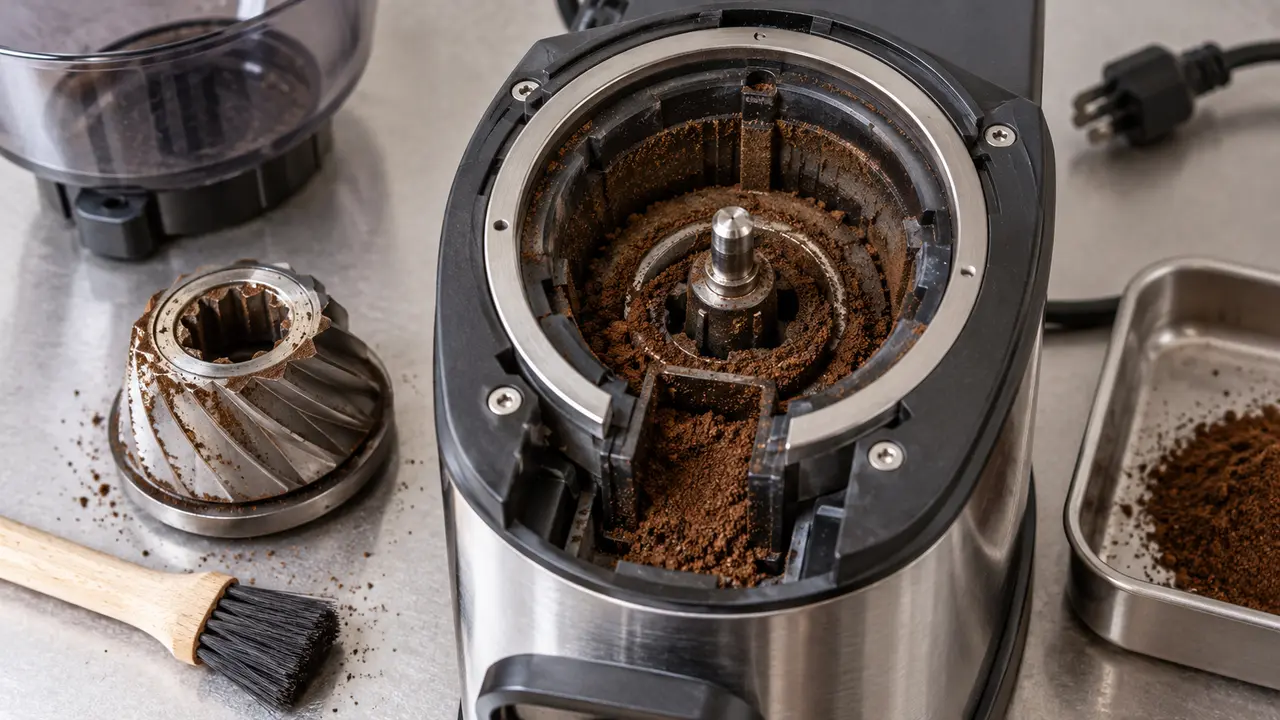
This guide applies to the Breville Barista Express BES870/BES870XL. “Grinder jammed” usually means the motor tries to run, the sound changes, or grounds stop reaching the portafilter. A completely silent grinder can instead involve the hopper interlock, activation switch, power control or motor. Use the symptoms below before taking anything apart.
| Symptom | Likely direction | First check |
|---|---|---|
| Motor hums but no coffee exits | Compacted chamber or blocked chute | Dry-clean burrs and chute |
| Grinder sounds strained or stops | Foreign object or dense buildup | Unplug immediately; inspect removable area |
| FILTER SIZE lights flash | Hopper not attached or locked | Remove debris and relock hopper |
| Grounds arrive slowly or in clumps | Partial chute blockage or moisture | Clean and dry chamber and chute |
| Grinder is completely silent | Interlock, switch or electrical issue | Grinder-not-working diagnostic |
| Loud metallic clicking continues after cleaning | Foreign object or damaged burr/drive | Stop and arrange service |
Before cleaning: important safety rules
- Switch the machine off and unplug it from the outlet.
- Keep fingers and tools away from the grinder while power is connected.
- Handle burr edges carefully; Breville warns that they are extremely sharp.
- Do not pour water, cleaning solution or rice into the grinder.
- Do not force the grind-size control while compacted beans prevent movement.
- Stop if a part does not release as shown in the official manual.
How to clear a Barista Express grinder jam
1. Remove the beans
With the machine off, turn the hopper to the unlock position and lift it away. Transfer usable beans to a clean, airtight container. If the hopper will not rotate normally, do not wrench it; brush visible beans away from the locking area and try again gently.
2. Remove the upper burr
Lift the wire handle, rotate the upper burr to unlock it and lift it straight out. Note its numbered setting before moving anything. This prevents an accidental grind-range change during reassembly. If your problem began immediately after an upper-burr adjustment, incorrect seating may be the cause.
3. Brush the burr chamber
Use the supplied cleaning brush to remove loose coffee from the upper burr, lower-burr area and chamber. Work slowly around sharp edges. Do not wet the burrs, and do not push compacted material deeper into the mechanism.
4. Clear the grinder outlet
Compacted coffee can block the passage between the burrs and the portafilter cradle. Breville’s advanced cleaning diagram instructs users to clear the grinds exit chute with the cleaning brush or a pipe cleaner. Work from the accessible outlet with the machine unplugged; do not insert rigid metal objects toward the motor.
5. Remove moisture and let everything dry
Breville lists water or moisture in the grinder chamber and chute as a cause of no ground coffee. If damp beans or a wet cleaning tool entered the grinder, leave removable parts out until completely dry. The manual notes that air from a hair dryer can be used in the chamber; use unheated or low-temperature airflow at a safe distance rather than heating plastic parts.
6. Reassemble and lock every interlock
Return the upper burr to its recorded number, press it fully into position and rotate it to LOCK. Install the hopper and lock it. Flashing FILTER SIZE lights indicate the hopper is not attached correctly; remove it, clear debris around the seat and try again.
7. Run a small controlled test
Add only a small handful of beans. Set a middle external grind position for the first test and pulse a short dose into an empty, dry portafilter. Stop immediately if the motor strains, metallic clicking returns or no grounds appear. Once flow is restored, use the grinder-settings guide to restore your espresso recipe.
Why Barista Express grinders jam
- Compacted fines: very fine coffee accumulates in the chamber or chute.
- Moisture: a damp burr, wet hopper or steam exposure causes grounds to clump.
- Oily or flavored beans: surface residue can make retained grounds stick together more readily.
- A foreign object: small stones and hard debris occasionally arrive with beans.
- Incorrect upper-burr seating: the burr may look installed but not be fully pressed and locked.
- Overheating: repeated grinding against a blockage can activate protection or damage the drive if operation continues.
What not to put in the grinder
Do not grind rice to “clean” the machine. Rice is harder and behaves differently from roasted coffee; fragments can add load and make a blockage worse. Do not use liquid grinder cleaner, spray lubricant or household oil. Use a dry brush and the official removable-part procedure.
When advanced cleaning or service is needed
The BES870 manual includes an advanced cleaning procedure for a blockage between the burrs and outlet. It goes deeper than routine upper-burr cleaning and involves small washers and the grinder fan. Follow the official illustrated sequence exactly if you are confident handling those parts; otherwise, stop at the removable upper burr and use a qualified technician.
Arrange service when the burrs are chipped, the drive slips, a foreign object cannot be removed safely, the motor only hums, or loud mechanical noise returns immediately after a correct dry cleaning. Our broader Barista Express grinder repair guide explains which symptoms point beyond a simple jam.
Prevent another blockage
- Keep the hopper, burrs and portafilter completely dry.
- Brush retained grounds before they compact in the outlet.
- Inspect beans for foreign material when filling the hopper.
- Make grind changes gradually and avoid forcing a stuck dial.
- Do not keep pressing the grind switch when the motor sounds strained.
- Clean more frequently when using dark, glossy beans.
Frequently asked questions
Why does my Barista Express grinder hum but not grind?
The motor is likely meeting resistance from compacted grounds, a blocked chute or a foreign object. Unplug the machine and inspect only the user-removable hopper and upper-burr area. Do not continue powering a stalled grinder.
Why are the FILTER SIZE lights flashing?
Breville identifies an incorrectly attached bean hopper as the cause. Remove the hopper, brush debris from its seat, reinstall it and turn it fully to the locked position.
Can I wash the grinder burrs?
Keep grinder components dry. Moisture is an official troubleshooting cause of blocked output. Use the supplied brush and allow any accidentally damp parts to dry completely before reassembly.
Why is coffee coming out slowly after cleaning?
The chute may still be partially blocked, the upper burr may not be fully locked, or the grind amount may be set too low. Switch off, recheck assembly and clear the accessible chute before changing the dose control.
Official references
- Breville Barista Express BES870XL instruction manual — conical-burr cleaning, blockage procedure, moisture warning and grinder troubleshooting.
- Breville Barista Express product page — current product information.
Information checked against Breville’s U.S. documentation on September 13, 2026. Regional versions and accessories may differ.