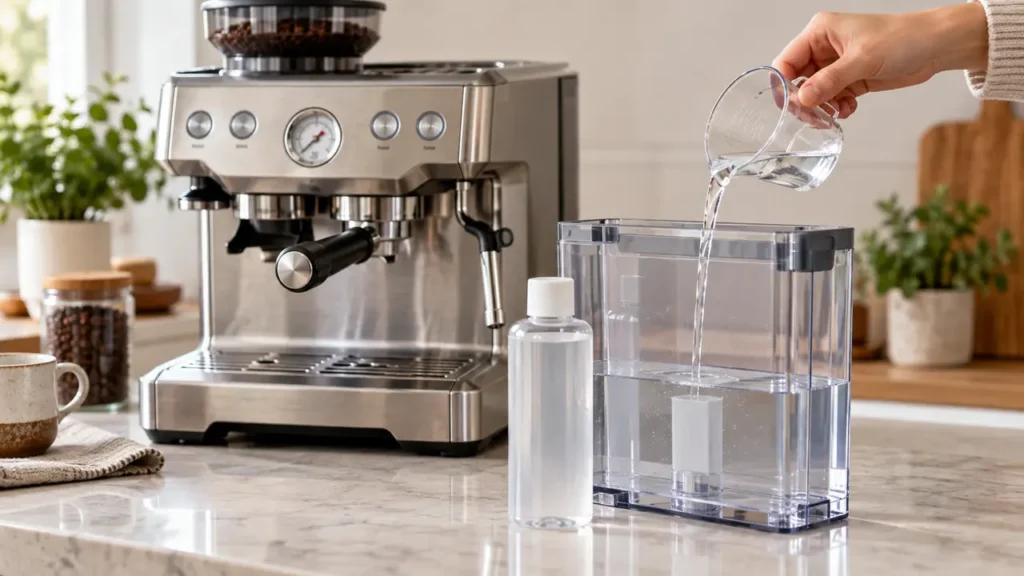
Use a descaling product made for espresso machines and follow the dose on the product label. For the U.S. Breville Barista Express BES870, Breville’s instructions specify one sachet of its descaling powder dissolved in 34 fl oz (1 L) of water. A cleaning tablet is not a substitute: it cleans coffee oils from the group head, while descaler removes mineral buildup from the water circuits.
Quick answer
- Safest choice: a genuine Breville espresso-machine descaler whose package lists your machine or directs you to the correct dose.
- Confirmed Breville option: Breville’s BES007 descaler product page explicitly lists the Barista Express BES870 as compatible.
- Correct U.S. BES870 dilution: one Breville sachet in 34 fl oz (1 L) of water, according to the machine manual.
- Do not use: a group-head cleaning tablet in the water tank, undiluted acid, mixed cleaning chemicals, or an improvised recipe with an unknown concentration.
The best descaling solution for a Breville Barista Express
The straightforward choice is a Breville descaling sachet intended for espresso machines. Breville currently sells single-dose the Machine Descaler™ sachets, while its BES007 descaler listing specifically names the Barista Express BES870 among the compatible models. Packaging and product names can vary by country, so check the model list and directions on the product you actually receive.
You do not need to guess the acid concentration when you use the machine manufacturer’s product. That matters because a solution that is too weak may leave scale behind, while an overly concentrated or poorly rinsed product can leave odor, taste, or unwanted residue in the water path.
Already have the correct sachet? Follow our complete Breville Barista Express descaling procedure, including the coffee, steam, and hot-water circuits and the final fresh-water rinse.
Descaler, cleaning tablet, steam cleaner, or water filter?
Breville separates these products because they solve different maintenance problems. Using the right cleaner in the right circuit is more important than the brand name printed on the packet.
| Product | What it removes | Where it is used | Is it a descaler? |
|---|---|---|---|
| Espresso-machine descaler | Hard-water mineral scale | Water tank and internal water circuits, following the descale program | Yes |
| Group-head cleaning tablet | Coffee oils and residue | Cleaning disc in the portafilter during the backflush/cleaning cycle | No |
| Steam-wand cleaner | Dried milk residue | Steam wand, according to its product directions | No |
| Water filter | Reduces selected impurities before water enters the machine | Inside the water tank | No; it does not remove existing scale |
If the CLEAN/DESCALE light is flashing, the BES870 is asking for the separate group-head cleaning cycle. If it is solid, the machine is indicating descaling. See our cleaning-tablet and cleaning-cycle guide if the light is flashing.
How much descaling solution should you use?
For the U.S. BES870 instructions, empty one Breville descaling-powder sachet into the water tank, add 34 fl oz (1 L) of water, and stir until the powder has dissolved. That is the concentration specified for the procedure in the official manual.
Do not assume that every sachet from every brand has the same strength. If you use a compatible third-party liquid or powder, follow that product’s dilution directions rather than copying the one-sachet measurement from a different formula. Never pour concentrate into the machine unless its label expressly instructs you to do so.
Important: never mix descaler with bleach, chlorine cleaner, a cleaning tablet, vinegar, or any other chemical. Empty and rinse the tank before changing products.
Can you use a generic espresso-machine descaler?
A third-party descaler can be a reasonable option when the manufacturer clearly labels it for espresso or coffee machines and provides an exact dilution and rinse procedure. Before using one in a Barista Express, check all of the following:
- The label says it is suitable for espresso or coffee machines, not only kettles or household surfaces.
- The maker identifies compatible machine materials or specifically lists Breville/Sage espresso machines.
- The package gives an unambiguous water-to-product ratio for one treatment.
- The instructions include a complete clean-water rinse after descaling.
- The product is within its use-by date and the sachet or bottle is undamaged.
If the label is vague about concentration or machine compatibility, the small saving is not worth the uncertainty. Use the Breville product or ask the descaler manufacturer to confirm compatibility in writing.
Can you descale a Barista Express with vinegar?
We do not recommend vinegar for the BES870. The official Breville procedure specifies a measured sachet of descaling powder, not household vinegar. Vinegar varies in concentration, can leave a persistent smell or taste when it is not rinsed completely, and gives you no model-specific dosing assurance.
The same caution applies to homemade citric-acid recipes. Citric acid is used in some commercial descalers, but the fact that an ingredient can remove scale does not tell you the correct concentration, contact time, additives, or rinse volume for this machine. A purpose-made product with clear directions is the more predictable choice.
What if you used the wrong product?
You put a cleaning tablet in the water tank
Do not brew coffee. Turn the machine off, remove and empty the tank, and rinse the tank thoroughly. Refill it with fresh water. If the tablet had already dissolved and the pump drew the mixture into the machine, run repeated fresh-water cycles through the coffee outlet and hot-water outlet until there is no foam, odor, or residue. If symptoms remain, stop using the machine and contact Breville support.
You used too much descaler
Do not add another chemical to neutralize it. Empty and rinse the tank, then perform additional fresh-water rinses. A chemical smell, unusual taste, persistent foam, leakage, or abnormal pump noise after rinsing is a reason to stop and request service advice.
The descale light is still on
The product may not be the problem. The BES870 procedure must run through all three paths—group head, steam wand, and hot-water outlet—and then be followed by the rinse sequence. Repeat the official sequence carefully before assuming that a stronger solution is needed.
Before you start
- Confirm the exact model number on your machine; this guide is for the Barista Express BES870 family.
- Remove coffee beans or accessories that could get wet while you work.
- Use a container large enough to catch water from the group head, hot-water outlet, and steam wand.
- Keep the solution packaging until the full rinse is complete.
- Allow a hot machine to cool enough to handle safely, and keep hands away from hot water and steam.
Next step: run the complete descale cycle
Once the correct solution is mixed, use the machine’s descale mode rather than simply pulling several espresso shots. Our step-by-step BES870 descaling guide covers the button sequence, timing for each water circuit, rinse stage, and how to exit the mode.
Official references
- Breville BES870 instruction manual
- Breville BES007 descaler compatibility page
- Breville the Machine Descaler™ product page
- Breville cleaning supplies guide
Featured photo: rohsstreetcafe, via Wikimedia Commons, licensed under CC BY-SA 2.0. Product names and instructions were checked on September 12, 2026. Always follow the label supplied with your product and the manual for your regional machine.