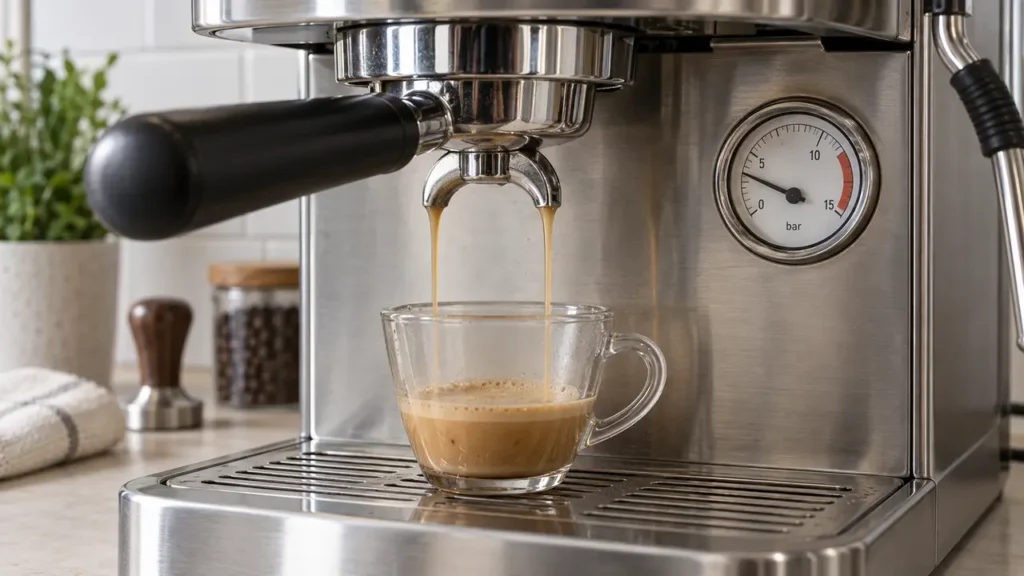
Low pressure on a Breville Barista Express is usually an extraction setup problem, not a failed pump. If the shot runs quickly, looks pale and tastes thin, make the grind slightly finer, confirm the dose and tamp level, then test again. If water flow is weak even without the portafilter, investigate the tank, blockage and scale instead.
Quick fix sequence
- Use fresh beans and the Single Wall 2 CUP basket.
- Measure approximately 15–18 g, the range given in Breville’s BES870 manual.
- Distribute evenly and tamp level with consistent force.
- Time the shot. If it finishes under about 20 seconds, adjust one step finer.
- Repeat with the same dose. Stop when flow, taste and shot time improve.
First: low pressure at the start is normal
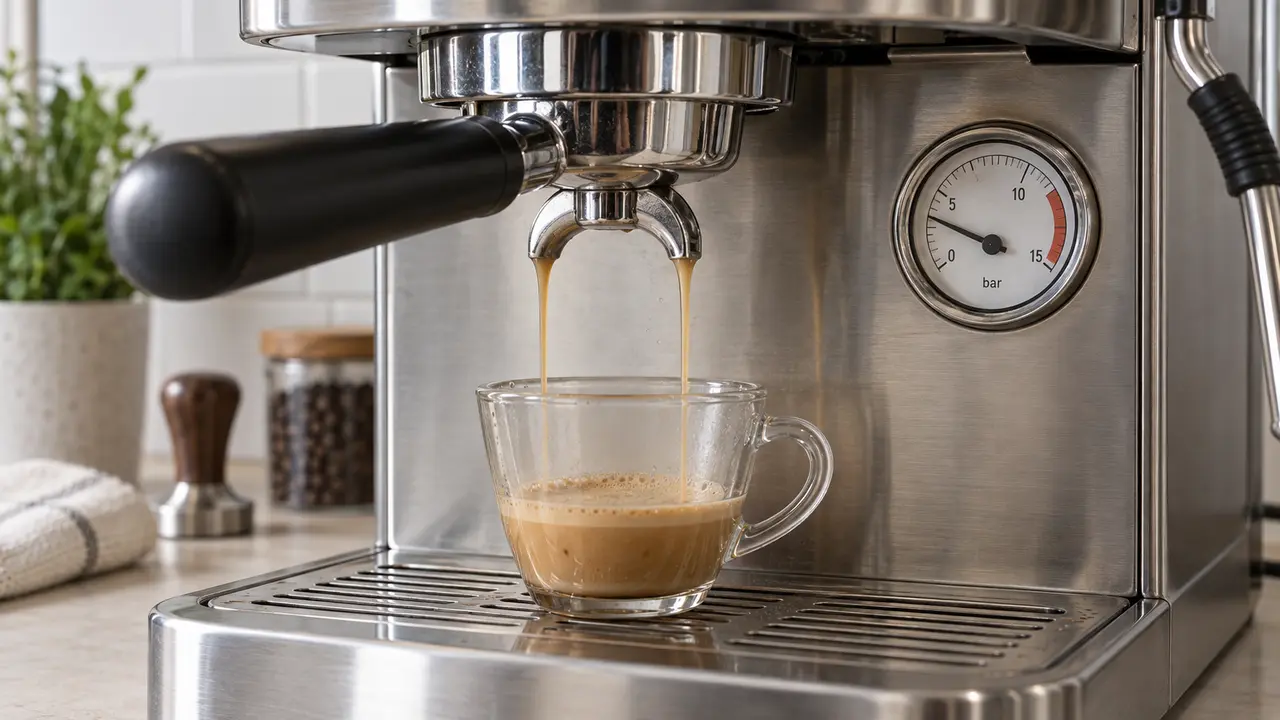
This guide applies to the Breville Barista Express BES870/BES870XL. The machine deliberately begins with low-pressure pre-infusion, so the needle should initially sit in the lower part of the dial. It then rises as full extraction begins and the coffee puck resists water flow. Do not diagnose a fault from the first few seconds alone.
Breville’s manual describes the solid gray area as the ideal espresso-pressure zone. It also links a reading in the lower zone to water moving too quickly through the puck, producing watery espresso with little crema or flavor. The listed causes are a grind that is too coarse, insufficient coffee and under-tamping.
What “not building pressure” looks like
| Symptom | Likely cause | Best next move |
|---|---|---|
| Needle stays low; shot runs like water | Coarse grind or low dose | Go slightly finer, keep dose constant |
| Needle stays low; espresso is pale and sour | Under-extraction | Increase puck resistance gradually |
| Pressure varies from shot to shot | Inconsistent dose, distribution or tamp | Weigh coffee and standardize preparation |
| Needle is low and water leaks around the rim | Poor portafilter seal or dirty rim | Clean and lock in correctly; inspect the seal |
| Needle is low and group-head flow is weak | Tank, blockage or scale issue | Check water supply and maintenance |
| Shot behaves normally but needle stays at zero | Possible gauge fault | Use the pressure-gauge diagnostic |
Establish a reliable baseline
Pressure reacts to resistance. Before replacing parts, make one repeatable recipe so each adjustment tells you something.
1. Choose the right basket
Use the Single Wall basket for freshly ground beans. Breville identifies the Dual Wall baskets for pre-ground coffee. Switching basket style changes how pressure is created, so compare shots only when the basket stays the same.
2. Start with fresh coffee
Older beans often need a finer setting and may still produce a weak-looking shot. Use beans with a roast date, keep them in an airtight container and avoid changing coffee halfway through diagnosis.
3. Measure the dose
The official manual gives approximately 8–10 g for the supplied 1 CUP basket and 15–18 g for the 2 CUP basket. Begin inside the appropriate range, distribute evenly and make the puck level. The top of the tamper’s metal cap should align with the basket rim after tamping when using Breville’s dose guide.
4. Tamp consistently
Breville specifies about 30–40 lb (15–20 kg), while also noting that consistency matters more than the exact force. Tamp once, level. Repeatedly pressing harder can hide a grind problem and makes comparison difficult.
5. Time from button press
Breville’s guide describes correct flow as starting after about 4–7 seconds, resembling warm honey and taking approximately 25–35 seconds. Under-extracted flow can start after 1–3 seconds and finish in 20 seconds or less. These are practical diagnostic ranges, not a rule that overrides taste.
How to raise pressure without overcorrecting
Adjust the grind first
If the shot is fast, move the external grind-size dial slightly finer. On the Barista Express, smaller numbers are finer and larger numbers are coarser. Purge a small quantity after the change because retained grounds can make the next dose a blend of two settings. Then repeat with the same coffee weight.
Do not make several large changes at once. If you reach the fine end of the external dial and shots still gush, the adjustable upper burr can extend the range. Breville recommends moving it only one number at a time. Follow our detailed Barista Express grinder-settings guide before changing the upper burr.
Correct the dose second
If the grind is close but the basket is visibly under-filled, increase the dose within the basket’s useful range. Do not pack in extra coffee merely to force the gauge upward. An overfilled basket can contact the shower screen, make the portafilter difficult to lock and turn a low-pressure problem into choking or leakage.
Improve distribution, not tamp force
Break up obvious clumps, spread the grounds evenly and tamp level. An uneven puck can channel: water finds a weak path, the shot runs fast and the dial may stay low even though part of the puck is dense. Consistent preparation makes the pressure reading more useful.
If grind and dose do not solve it
Check grinder output
If the setting changes but the grounds do not become finer, the upper burr may be unlocked, worn or incorrectly seated, or the chute may be partially blocked. If the grinder produces little or no coffee, use the grinder-not-working diagnostic. For mechanical symptoms, see the grinder repair guide.
Clean the filter basket
Hold the clean basket toward a light and inspect the holes. Use the pin on Breville’s cleaning tool for a blocked hole. The manual says a stubborn basket can be soaked for about 20 minutes in hot water with a dissolved cleaning tablet, then rinsed thoroughly. Never enlarge a hole with a drill bit or sewing needle.
Check the portafilter seal
Wipe grounds from the basket rim and group-head mating surface before locking in the portafilter. Water escaping around the edge bypasses the puck and can reduce useful pressure. Persistent leakage with correct locking can indicate a worn shower-screen silicone seal.
Check water flow and scale
Remove the portafilter and run a brief flush. If water is weak or absent, fully seat a filled tank and let the machine reach operating temperature. Scale is another official troubleshooting cause for poor group-head flow. If maintenance is due, follow the correct descaling procedure. A cleaning tablet cycle removes coffee oils from the brewing path; it is not the same as descaling mineral deposits.
When low pressure points to service
Arrange qualified service if pressure remains low after a controlled puck test and routine maintenance, especially when one or more of these symptoms is present:
- Group-head flow is weak after the water tank is filled, seated and the prescribed descale procedure is complete.
- The pump sound has changed sharply, becomes unusually loud or stops under load.
- Water leaks inside the case or beneath the machine from somewhere other than the drip tray.
- Steam and hot-water performance have also deteriorated.
- The shot extracts normally but the gauge never responds, suggesting a separate gauge issue.
Internal pump, valve, over-pressure and gauge-line work exposes hot water, mains electricity and pressurized components. The BES870 manual tells owners to contact Breville Consumer Support for maintenance beyond cleaning. Unplug the machine if it leaks internally or behaves abnormally.
Common mistakes that keep pressure low
- Changing grind, dose and tamp at the same time.
- Testing with an empty basket and expecting the espresso gauge to rise.
- Using stale beans while copying another person’s grind number.
- Failing to purge retained grounds after changing the dial.
- Tamping much harder instead of moving a coarse grind finer.
- Confusing the cleaning-tablet cycle with descaling.
- Chasing the top of the gauge at the expense of shot taste and flow.
Frequently asked questions
Why is my Breville Barista Express not building pressure?
Most often, water is passing through the coffee too easily because the grind is too coarse, the dose is too low or the puck is uneven. Start with a measured dose and move one grind step finer. If water flow itself is weak, check the tank, basket, group head and scale instead.
What pressure should the Barista Express show?
The BES870 dial is zoned rather than numbered. Breville says the needle should begin in low-pressure pre-infusion and then move into the solid gray espresso range for ideal extraction. Use the zone with shot time, flow and taste rather than trying to hit a specific numeric bar value.
Will a finer grind increase pressure?
Usually yes, because finer coffee creates more resistance. Adjust in small steps. If espresso already drips slowly or takes more than about 40 seconds, going finer is the wrong direction.
Can old beans cause low pressure?
Yes. As beans age, the same grind setting can produce faster flow, thinner crema and less puck resistance. A finer setting may compensate partly, but fresh beans make diagnosis and dial-in more consistent.
Does low pressure mean the pump is failing?
Not by itself. A fast watery shot with normal group-head flow usually points to coffee preparation. Suspect a water-path or pump problem only after a controlled extraction test, routine cleaning and descaling checks fail.
Official references
- Breville Barista Express BES870XL instruction manual — gauge zones, dose ranges, extraction timing, grinder adjustment and troubleshooting.
- Breville Barista Express product page — current product information and specifications.
Information checked against Breville’s U.S. documentation on September 12, 2026. Model revisions and regional accessories can differ.