Cover image: representative equipment, not an exact model or control-layout reference. Use the model-specific instructions below for checks and adjustments.
Quick answer: Start with the cup and the exact K-Supreme version. On the original model with STRONG and OVER ICE buttons, there is no user temperature selector; K-Supreme Gen 2 has temperature choices. Compare fresh black coffee in a warmed mug before adding cold milk. If it is still unexpectedly lukewarm, a single plain-water brew can help separate drink preparation from a broader heating or flow problem. A cup reading alone does not identify a failed heater. Stop for leaks, a burning smell, repeated shutdowns or cold output, and contact Keurig rather than opening the brewer or resetting an internal thermostat.
Which K-Supreme do you have?
Check the name and product information before following a button sequence. K-Supreme, K-Supreme Plus, SMART and Gen 2 are not interchangeable labels.
| Version | Temperature advice |
|---|---|
| Original K-Supreme: STRONG, OVER ICE, 6/8/10/12 oz buttons | Its documented controls do not offer a temperature adjustment. STRONG changes the coffee’s intensity; it is not a thermostat setting. |
| K-Supreme Gen 2 | Keurig lists Warm, Hot and Max Hot settings. Check the selected temperature using that version’s instructions. |
| Plus or SMART | Use its own guide and controls. The original-model sequence below is not a substitute for its settings instructions. |
The following button steps apply to the original K-Supreme. Use a normal hot-coffee selection for the comparison, without ice or OVER ICE mode. Do not try hidden button combinations to “unlock” a hotter setting.
First compare the drink before milk
A heavy, cold mug absorbs heat, and cold milk lowers the finished drink’s temperature. That does not establish a brewer fault. Keurig’s general temperature FAQ also notes that cup material affects the result; its older-model temperature figures should not be treated as a K-Supreme in-cup pass/fail specification.
You need: a heat-safe mug large enough for the selected drink, the same type of pod you normally use, and a few minutes. A food thermometer is optional. No screwdriver or replacement part is needed.
- Warm the mug separately. Rinse it with hot water suitable for the mug, then carefully empty it. Keep the counter dry. Do not put hot water into the brewer’s reservoir as a workaround.
- Brew your usual size. Use a fresh pod and let the cycle finish. Keep the handle closed while brewing.
- Compare before adding anything. Assess the black coffee once safe to sip, then note the difference after your usual amount of milk or creamer. Do not change mug, pod and cup size together.
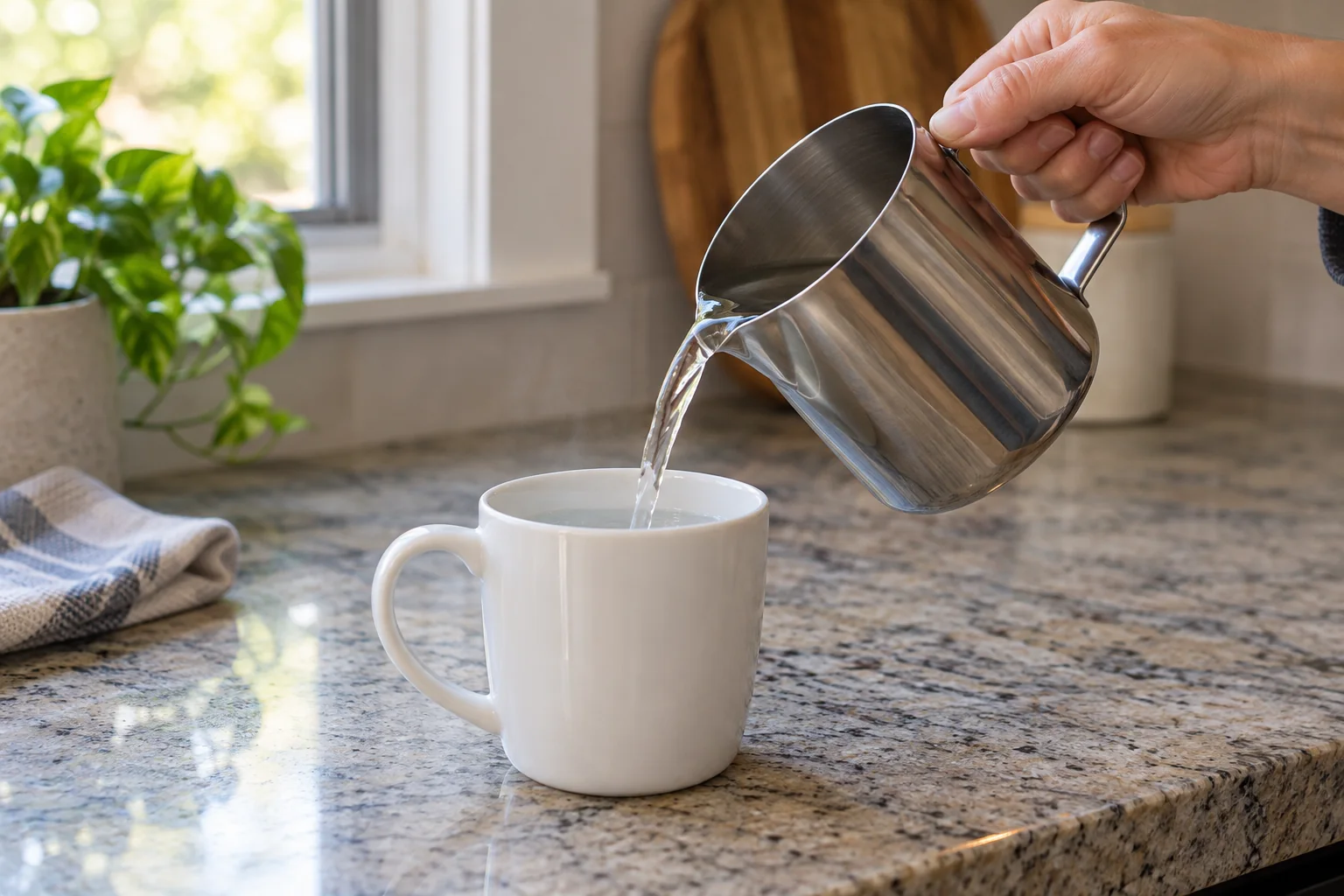
If the warmed cup solves the complaint, keep that routine. If the drink is hot before milk but cooler afterward, focus on the amount and temperature of the addition. Neither result calls for a heater replacement.
Still lukewarm? Try one plain-water comparison
This is an observation step based on the original brewer’s documented cleansing-brew procedure, not a calibrated heater test. Skip it if there is a leak, damage, a burning smell or repeated shutdown.
- Make sure the reservoir contains fresh water and is seated correctly. Do not use distilled water.
- Place a heat-safe mug holding at least 10 oz on the drip tray.
- After the previous cycle has finished, remove any used pod. Lower the handle with no pod installed.
- Select 8 oz, then press the blinking brew button. The original K-Supreme heats and brews as one process; a separate warm-up-button sequence is unnecessary.
- Leave the handle closed until dispensing finishes. Note whether the output is a full serving and whether it appears unexpectedly cool. Do not put fingers under the stream to test it.
If you use a food thermometer, measure in the cup after dispensing, following the thermometer’s instructions. Keep the mug, volume and timing consistent. Record the result for support; do not compare it directly with an internal heater temperature quoted for a different brewer.
Use the result to choose the next step
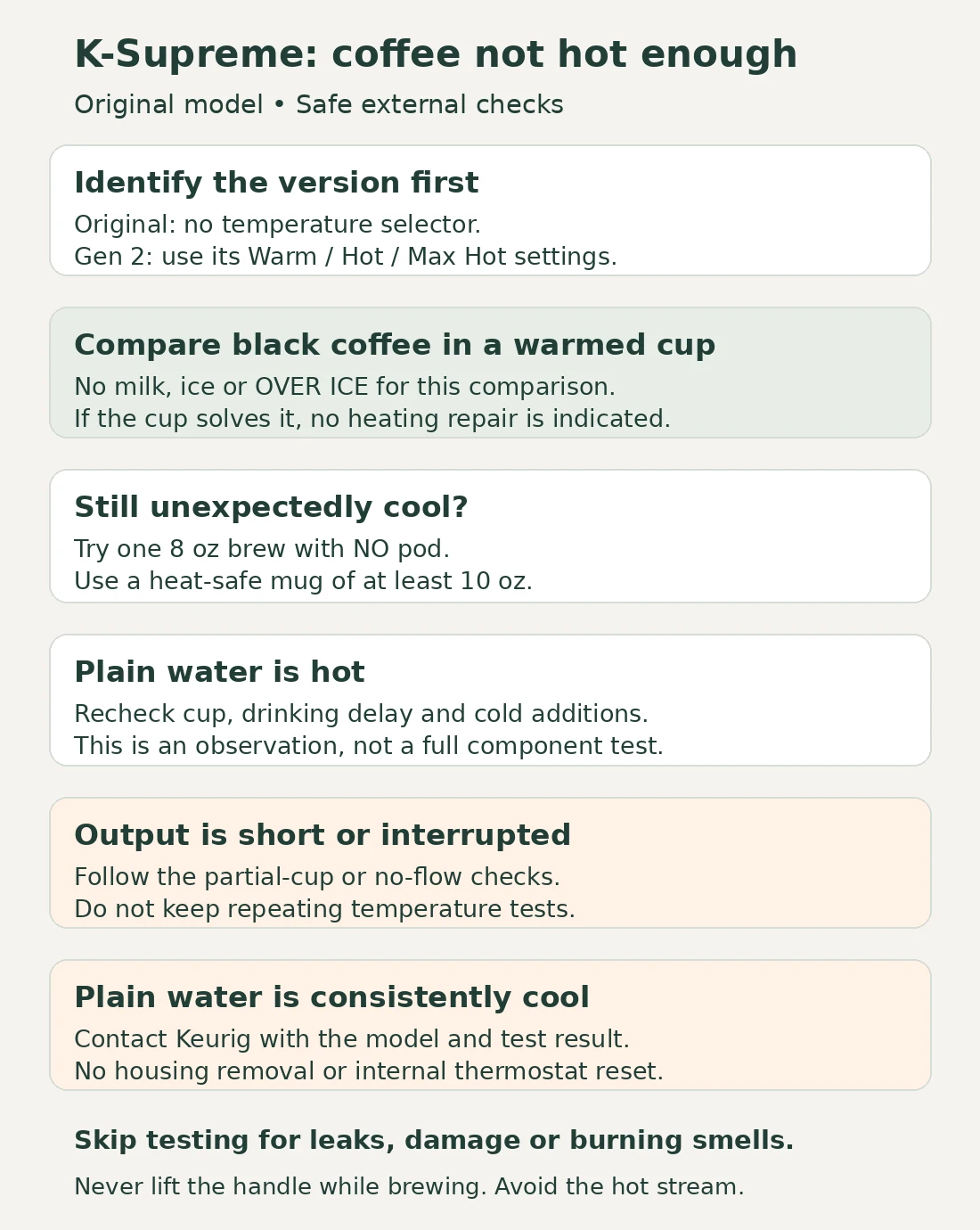
- Plain water is hot; the prepared drink cools quickly: revisit the cup, delay before drinking and cold additions. This shows the brewer can heat water during that test, not that every internal part has passed inspection.
- The serving is short, slow or interrupted: follow the K-Supreme partial-cup checks. Investigate the flow symptom rather than repeatedly testing temperature.
- Water and coffee are both consistently much cooler than before: contact Keurig with the result, model information and maintenance history. Do not keep running cycles to try to make it heat.
- Nothing dispenses: use the K-Supreme won’t-brew guide. A no-flow condition cannot be diagnosed from cup temperature.
Where descaling fits
Scale can hinder brewer performance, so review whether descaling is due or the DESCALE light is on. Use the original K-Supreme descaling guide and complete the prescribed rinse. Descaling is maintenance, not proof that scale caused a particular cold cup.
If the brewer is dispensing cold water, stopping repeatedly or no longer powering on, do not start repeated chemical cycles. For a machine that went completely dead during or after descaling, see the separate no-power guide. An internal thermal-protection reset is not an owner step in this article.
When service is the better next step
Stop for water around electrical parts, a damaged cord, smoke or a burning smell. Turn off and unplug only when safe. The original K-Supreme guide limits owner work to its recommended cleaning and maintenance; internal heating faults need support.
Provide your exact version, whether the change was sudden, the selected cup size, any DESCALE indication, and whether the plain-water serving was hot, cool or incomplete. A photo of the controls helps avoid advice for the wrong generation. The symptom alone cannot identify a heater, sensor or control-board replacement, so no speculative parts list or repair price is given here.
Common questions
Will STRONG make the original K-Supreme hotter?
Keurig describes it as a bolder-coffee option, not a temperature control. Use it for taste rather than as a heating repair.
Should the coffee be boiling?
No. Do not use boiling as the target for this check. Brewing temperature, the temperature leaving the outlet and the temperature after reaching your mug are different measurements.
Can a factory reset fix cold output?
The original K-Supreme owner guide does not prescribe a factory-reset sequence for this symptom. Record the cup and flow comparisons and contact support if it persists.
Sources and related help
This guide uses manufacturer documentation and a practical comparison workflow. It does not claim hands-on temperature testing. The original illustrations show representative equipment rather than exact product controls.
- Original K-Supreme Use & Care Guide — controls, cleansing brew, Smart Start, maintenance and service limits.
- Keurig K-Supreme Gen 2 product page — three temperature options.
- Keurig general brewer FAQ — cup-material effects and scale-related maintenance. Older-model temperature figures are not used as K-Supreme test limits.
Browse the K-Supreme model guide for other symptoms.