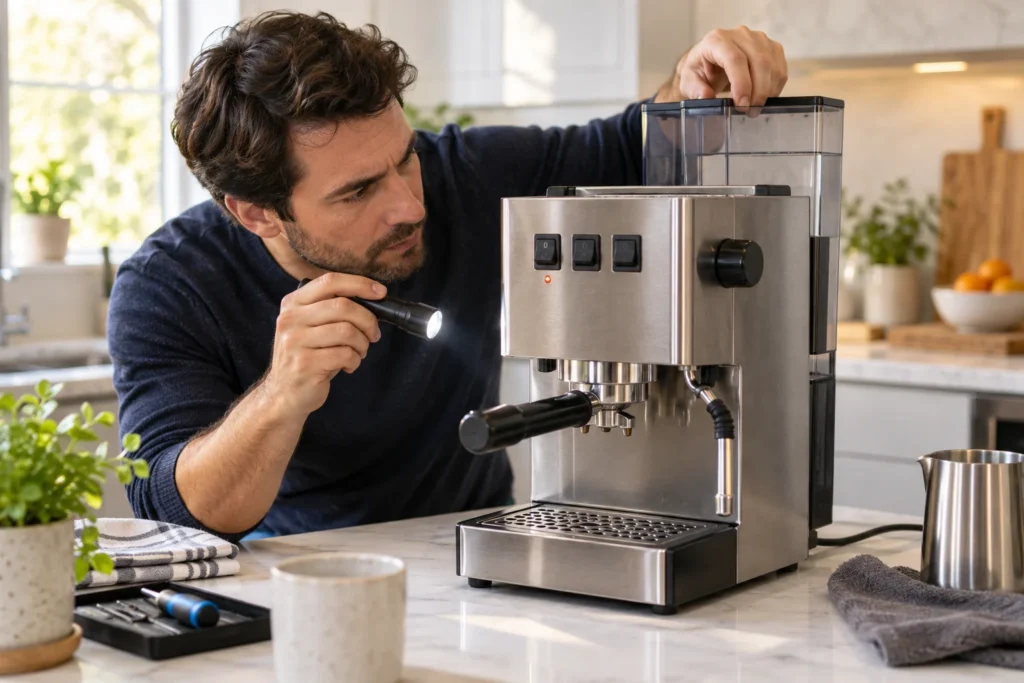
Most Gaggia Classic Pro problems can be narrowed down without opening the case. First remove the portafilter, fill and correctly seat the water tank, let the machine heat, then compare water flow from the group head and steam wand. That simple test separates coffee-preparation problems from a blocked water path, an air lock, scale, or a fault that needs professional service.
Safety first: the group head, boiler, portafilter and steam wand can remain hot and pressurized after use. Switch the machine off, unplug it and allow it to cool before cleaning, removing accessories or inspecting a leak.
Stop immediately if water reaches the power cord or switch area, the cord is damaged, the machine trips a breaker, or you smell burning insulation. Do not remove the case or test live electrical parts.
Last verified: September 19, 2026
Before troubleshooting: identify your Classic
This guide focuses on the Gaggia Classic Pro / New Classic family, including many RI9380 variants sold in North America and other markets. Controls, boiler material, factory pressure calibration and included baskets can differ by production year and region. The current North American Classic Pro E24, for example, uses a lead-free brass boiler and a factory 9-bar over-pressure valve, while earlier Classic Pro units may have a different boiler and regional configuration.
Check the model and voltage label on the underside or rear of your machine before ordering parts or following a model-specific repair video. This page covers safe external diagnosis. It does not assume that every Classic, Classic Pro and E24 has identical internal components.
Gaggia Classic Pro troubleshooting chart
| Symptom | First safe test | Most likely direction |
|---|---|---|
| No water from group head | Remove portafilter and test the steam wand | Air lock, empty/mis-seated tank, scale, or blocked brew path |
| Pump is loud | Check tank level and prime through the steam wand | Pump is drawing air or the circuit is not primed |
| Espresso runs too fast | Time a shot with fresh coffee | Grind too coarse, insufficient dose, or weak/uneven tamp |
| Espresso barely drips | Run water with the portafilter removed | Coffee too fine/overdosed if free flow is normal; blockage if it is not |
| Water leaks around portafilter | Clean basket rim and group gasket | Coffee on the seal, incorrect locking, overfill, or worn gasket |
| Weak or no steam | Purge briefly after steam-ready light | Blocked tip, incomplete heating, scale, or steam technique |
| Coffee is cold | Preheat machine, portafilter and cup | Insufficient warm-up or a heating/control fault |
| Machine has no power | Test the outlet with another appliance | Outlet/cord issue or internal electrical fault requiring service |
Start with a three-path water-flow test
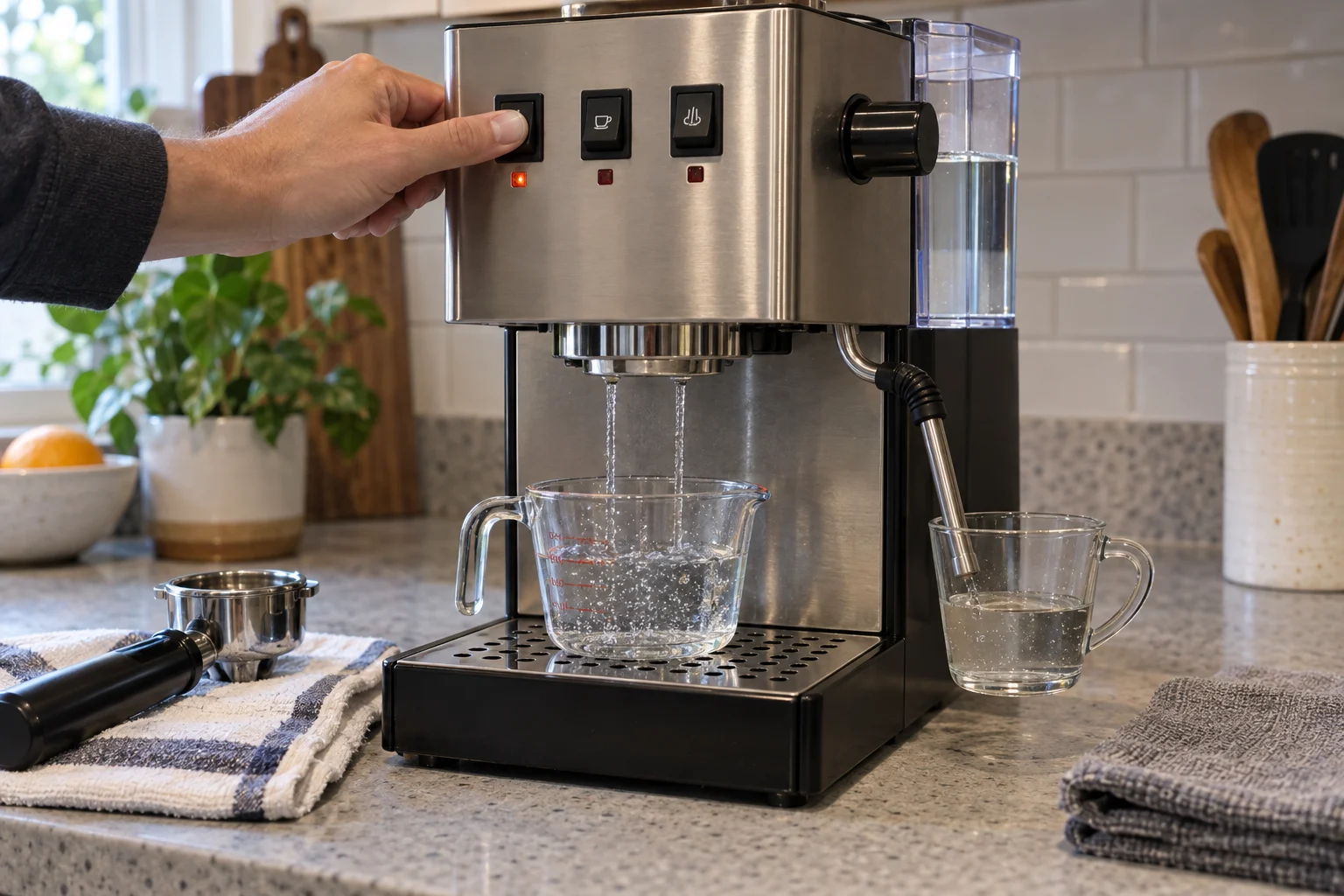
This is the most useful diagnostic test because it removes the coffee puck from the equation. Fill the reservoir with cold drinking water and make sure both intake tubes are inside the tank. Remove the portafilter, place a container under the group head, turn the machine on and allow it to reach brew temperature.
- With the steam knob closed and steam switch off, activate the brew switch for several seconds.
- Observe whether water flows evenly from the group head.
- Turn the brew switch off. Place a second container under the steam wand.
- Slowly open the steam/hot-water knob, activate the brew switch and compare the flow from the wand.
- Stop the pump after the test. Do not repeatedly run it dry.
How to read the result
- Normal group and wand flow: the machine can move water. Focus on grind size, dose, tamp, basket choice and portafilter cleanliness.
- No group flow, but good wand flow: the problem is likely downstream of the boiler toward the group, such as a dirty shower screen, scale or a valve restriction.
- No group flow and no wand flow, with a loud pump: check the tank and prime the circuit. An air lock or blocked intake is more likely than a coffee problem.
- No flow and the pump is silent: stop. A switch, pump or electrical fault may require qualified service.
- Water appears inside or beneath the housing: unplug the machine and arrange service. Do not continue leak testing while it is energized.
Gaggia Classic Pro not brewing or not pumping water
If the pump sounds unusually loud, it is often drawing air instead of water. Confirm the tank is filled, seated correctly and not pinching the intake tubes. The official RI9380 manual notes that the self-priming pump may temporarily fail because of an air bubble.
Prime the circuit safely
- Place a large cup under the steam wand.
- Open the steam/hot-water knob counter-clockwise.
- Turn on the brew switch to activate the pump.
- When a steady stream emerges, dispense roughly one cup of water.
- Turn off the brew switch, then close the knob.
If the pump does not begin moving water within a short test, switch it off and recheck the reservoir. Repeated dry running can overheat or damage a vibration pump. If priming works through the wand but the group remains dry, clean the external group components and assess scale history.
Espresso flows too fast, too slowly or not at all
When water flows normally without the portafilter, the machine is usually not the first suspect. The coffee puck controls resistance. Change only one variable at a time so the result is meaningful.
If the shot runs too fast
- Grind finer in small steps.
- Use fresh coffee suited to espresso.
- Confirm the basket is receiving an appropriate, repeatable dose.
- Distribute evenly and tamp level rather than simply tamping harder.
- Check that you are using the correct basket and insert combination for your setup.
The official manual treats a shot finishing in under about 20 seconds as too fast and directs the user to check for a coarse grind and proper tamping. Treat that number as a diagnostic clue, not a universal recipe: basket, dose, coffee and desired beverage yield still matter.
If the shot chokes or only drips
Remove the portafilter and run the group-head test. If bare group flow is healthy, grind slightly coarser, reduce an excessive dose and verify that the basket holes are clear. If bare group flow is weak, do not keep adjusting coffee. Clean the shower screen area and consider whether descaling is overdue.
Water leaks around the portafilter
A leak at the rim is different from normal water entering the drip tray through the drain tube after brewing. For a rim leak, let the machine cool, remove the portafilter and clean coffee from the basket edge and group gasket. Reinsert the portafilter squarely without forcing it.
If the leak remains, test with a normal dose rather than an overfilled basket. A hardened, cracked or flattened group gasket may need replacement. Stop using the machine if water comes from behind the front panel, from the switch area, or from an unknown point inside the case.
Weak steam or milk that will not froth
First separate a steam-production problem from a blocked tip. Wait for steam temperature, place an empty pitcher under the wand and briefly open the knob. A strong initial purge followed by weak steam often points to technique or the limits of a small single boiler; no output may indicate a blocked nozzle or water-path problem.
- Switch the machine off and let the wand cool completely.
- Wipe the exterior with a damp cloth.
- Remove the tip only as described for your variant and rinse its holes.
- Reinstall it correctly, heat the machine and purge for one or two seconds.
- Use cold milk and avoid burying the tip too deeply in the pitcher.
The Gaggia manual identifies a clogged steam nozzle, excessive insertion depth and milk that is already too hot as common causes of poor frothing. If the wand also has weak hot-water flow, investigate the hydraulic path rather than milk technique alone. For model-specific steam checks, follow our Classic Pro steam-wand guide.
Cold espresso or inconsistent temperature
The Classic Pro is a single-boiler machine, so preparation and timing affect temperature. Install the clean portafilter loosely during warm-up so the metal group and portafilter heat together. Preheat the cup with hot water and wait for the coffee-ready light before brewing.
If the steam switch was recently used, return the machine to brew mode and lower the boiler temperature according to the manual before pulling another shot. If the machine never becomes hot, its ready light behaves abnormally, or heating stops unpredictably, discontinue use and seek service rather than opening the energized machine.
Safe cleaning that solves many common problems
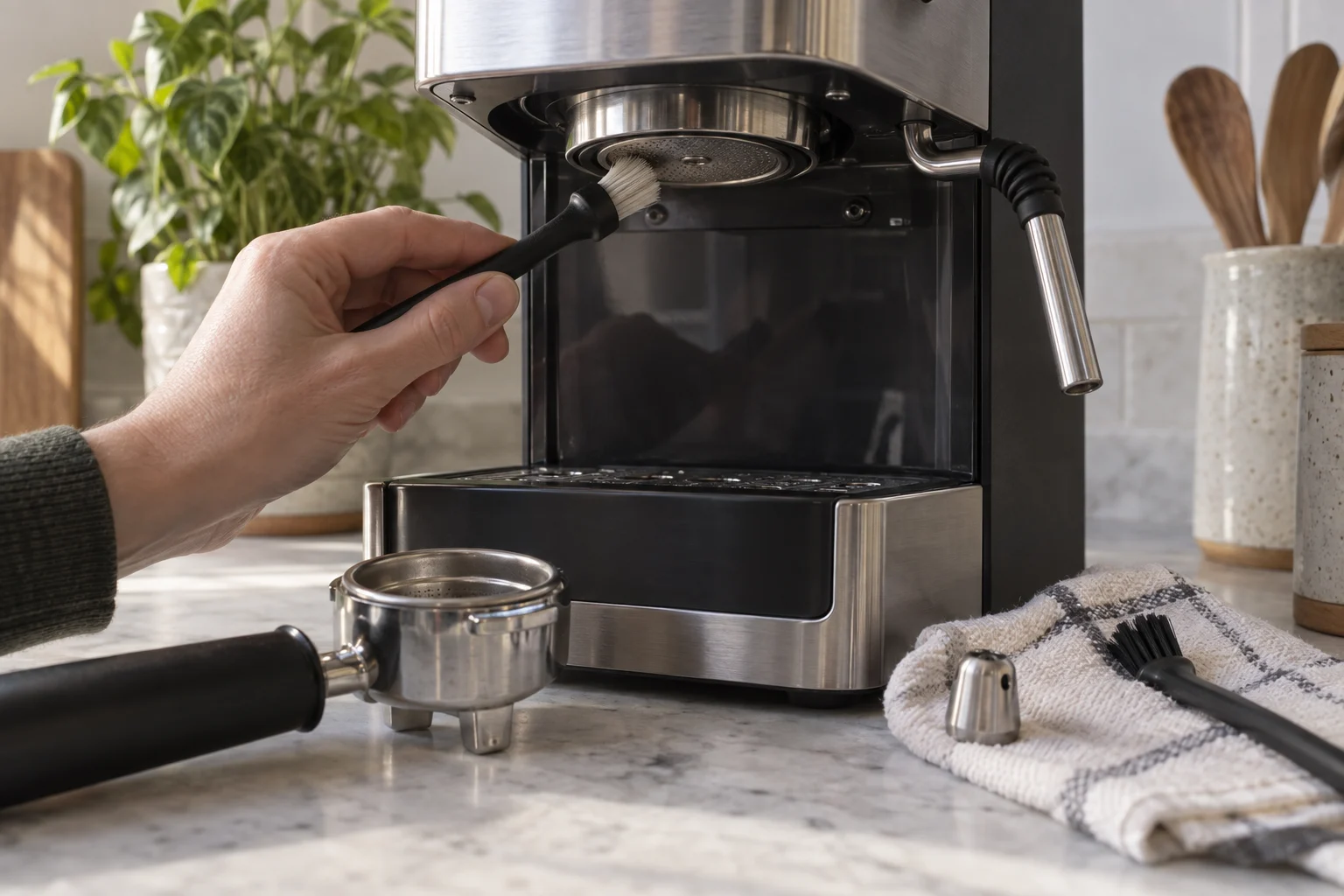
Coffee oils and fine grounds can restrict the basket, shower screen and steam tip. Regular external cleaning often restores flow without parts replacement.
- Rinse the basket and portafilter after use; keep the locking rim free of grounds.
- Brush loose coffee from the shower screen only after the group has cooled.
- Wipe and purge the steam wand immediately after milk use.
- Wash the drip tray and reservoir with non-abrasive tools.
- Use a manufacturer-compatible cleaning tablet only for the procedure intended for your machine.
- Descale on a water-hardness-appropriate schedule with Gaggia-compatible descaler; do not substitute vinegar.
Do not treat cleaning and descaling as interchangeable. Cleaning products target coffee oils; descaler targets mineral deposits. More chemical is not better, and a strong acid mixture can damage finishes, seals or internal materials.
When to stop and arrange professional service
Owner-level diagnosis should stop at safe external checks. Arrange qualified service when:
- the outlet works but the machine has no power;
- the pump remains silent when brew is selected;
- water leaks from inside the housing or near electrical controls;
- the machine trips a breaker or GFCI/RCD;
- there is a burning smell, smoke or visible cord damage;
- the boiler does not heat or overheats;
- safe priming, external cleaning and correct descaling do not restore flow.
Internal work exposes mains voltage, hot water and boiler pressure. The official manual states that servicing beyond cleaning and user maintenance should be performed by authorized service personnel.
Tools and supplies for safe diagnosis
- Two heat-resistant cups or measuring containers
- Soft cloth and group-head brush
- Small steam-tip cleaning tool appropriate for the nozzle
- Fresh coffee and a scale for controlled shot testing
- Gaggia-compatible cleaning tablets or descaler only when the diagnosis calls for them
Most external checks cost nothing. Routine cleaning supplies are usually inexpensive, while internal pump, valve, thermostat or boiler work should be quoted by a service provider before parts are ordered.
Frequently asked questions
Why is my Gaggia Classic Pro pump loud?
A louder, sharper pump sound commonly means the pump is drawing air. Check the tank level and intake tubes, then prime the circuit through the steam wand. Stop if the pump cannot establish flow after a short controlled attempt.
Why does water come from the steam wand but not the group head?
That result shows the pump can move water through at least part of the circuit. A dirty shower screen, mineral restriction or brew-path valve problem becomes more likely. Clean only accessible external parts and use professional service if flow does not return.
Why does my Gaggia Classic Pro leak after brewing?
A small discharge into the drip tray can be normal as pressure is released. Water escaping around the portafilter usually points to coffee on the sealing surfaces, overfilling, incorrect insertion or a worn group gasket. An internal leak is not normal.
Can I use vinegar to descale a Gaggia Classic Pro?
No. Gaggia’s RI9380 manual instructs owners to use Gaggia descaling product and explicitly says not to use vinegar or other descaling agents.
Should I open the machine to test the pump or thermostat?
Not for basic troubleshooting. The machine contains mains-voltage components, hot water and pressure. If external checks point to an internal electrical or hydraulic fault, use an authorized or qualified espresso-machine technician.
Official documentation
Procedures and safety limits in this guide were checked against the official Gaggia RI9380 operating instructions and the official Gaggia North America Classic Pro E24 specifications. Confirm the model label and use the manual supplied with your exact regional variant.
For other machines and symptom-specific help, browse the CoffeeFixGuide repair guide directory or return to the coffee machine problem finder.