Quick answer: Remove the portafilter and briefly press Brew with a full water tank. If water comes from the bare group head, the restriction is likely in the basket, coffee puck or portafilter. If the group stays dry, check the tank and intake tubes, then prime through the steam wand using Gaggia’s procedure. Stop if neither outlet begins flowing; do not keep the pump running dry.
This guide is for the U.S. Gaggia Classic Pro family described in Gaggia’s RI9380 manual. Classic, Classic Evo Pro and newer E24 versions may have different components and supplied filters. Check your exact model label and its manual before ordering parts. The cover is a generic editorial illustration; use the button names in your manual, not the pictured control panel.
Diagnose the route before buying a part
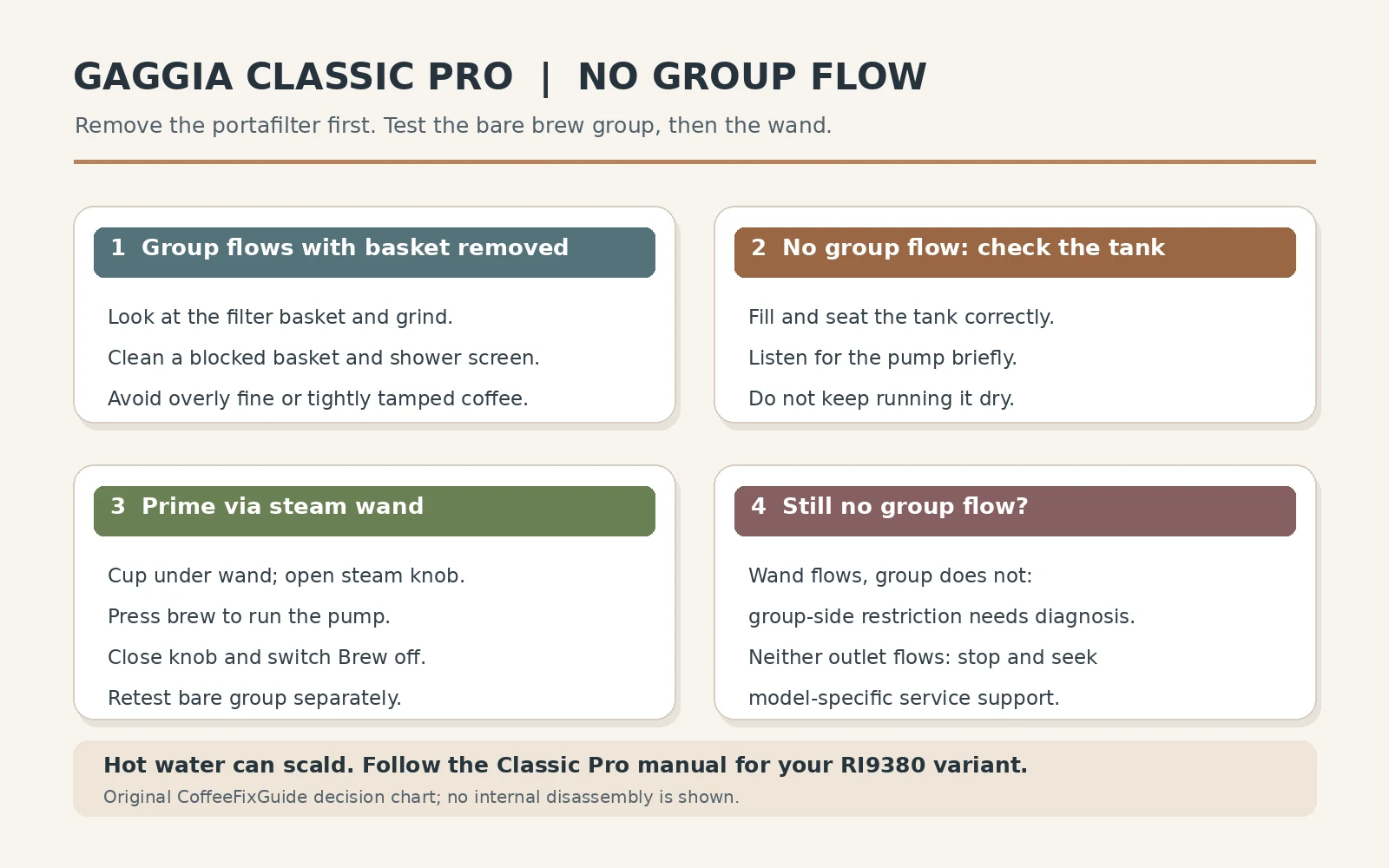
| What happens | Next check | What it does not prove |
|---|---|---|
| Group flows with portafilter removed | Basket, grind and packed coffee | It does not prove the pump is faulty. |
| No group flow, but wand starts after priming | Switch Brew off; retest bare group separately with wand knob closed | One wand test does not identify the exact group component. |
| Wand flows, group remains dry | Group-side restriction; seek model-specific diagnosis | Do not assume a solenoid valve without checking the variant. |
| Neither outlet flows | Tank, intake tubes, air in circuit; then service | A noisy pump alone does not establish that it must be replaced. |
Tools and safety
Have fresh cold water, two heat-safe cups, a towel and a soft cleaning brush. No screwdriver or electrical meter is needed for these owner-level checks. The brew group and steam wand can release scalding water. Keep fingers away from the outlets, use the knob rather than touching the metal wand, and let the portafilter cool before removing its basket.
Stop for a burning smell, leakage near the cord, a tripping circuit or an unfamiliar harsh mechanical sound. Do not leave the pump running against an empty tank or a no-flow condition while you investigate.
1. Test the bare group
- Switch Brew off. Carefully remove the portafilter once pressure has been released and it is safe to handle.
- Fill the tank and put a cup under the bare brew group. Make sure the steam knob is closed and the machine is in normal brew mode.
- Press Brew only long enough to observe whether a stream begins, then switch it off. In Gaggia’s circuit-loading procedure, water normally appears after a few seconds and the pump can be heard.
If the group flows: remove the cooled basket and wash it. Gaggia says to keep filters clean and, for a brewing malfunction, describes soaking the removable filter in boiling water for ten minutes and rinsing it. Use suitable utensils and avoid the hot water. Brush residual grounds from the group screen once it has cooled. Try a less fine grind or less tightly packed puck; the manual lists a clogged filter from coffee ground too fine or pressed too firmly as a cause of no brewing. If using the supplied pressurized “crema perfetta” basket, retain its matching frothing jet device as specified by Gaggia; using that basket without it may spray hot coffee.
If the bare group stays dry: the basket cannot explain the entire symptom because it is no longer in the flow path. Continue with the tank and priming checks.
2. Inspect the tank and intake tubes
Confirm that the tank contains water and is fully seated. For the Classic Pro arrangement in Gaggia’s manual, the silicone intake tubes must sit inside the tank without being twisted or blocked when it is reinserted. Check visually rather than pulling at hot or internal components. A loud pump following a refill or a long period of inactivity can accompany an air bubble, which the manual addresses by loading the circuit.
If the machine was unused for more than two weeks, Gaggia also provides a longer first-use flushing sequence. Follow your own manual for that procedure after normal flow has returned; do not run a whole tank through a machine that still has no output.
3. Prime through the steam wand
Gaggia’s circuit-loading instruction gives this sequence when water does not leave the brew unit:
- Place a heat-safe cup beneath the steam wand.
- Open the steam/hot-water knob counterclockwise.
- Press Brew to activate the pump. Watch the wand without touching it. If water starts after a few seconds, dispense about one cup.
- Close the steam knob, then press Brew again to switch the pump off, as the manual directs.
- Put a cup beneath the bare group. With the wand knob closed, perform a separate brief Brew test and switch it off when the result is clear.
This is a controlled priming attempt, not a reason to let the pump run indefinitely. If no water appears promptly, switch Brew off, recheck the full tank and intake tubes, and seek support. Hot water may emerge suddenly when an air pocket clears.
What the result means
Wand and group now flow: the circuit likely needed priming. Refit the cleaned basket and try an espresso with a reasonable grind and dose. Watch for a repeat no-flow condition; recurring air entry, tank seating or a restriction still needs attention.
Wand flows but group remains dry: the supply reached the wand, so the group route deserves separate inspection. A service diagnosis may consider a blocked group or solenoid path, but do not order a valve based on this observation alone. Whole Latte Love’s Classic Pro technical support also treats no brew flow with available steam as a group/solenoid branch; internal cleaning or replacement is beyond these owner checks.
Neither outlet flows: stop repeated attempts. Record whether the pump is audible, whether water is drawn from the tank and whether water leaks under the machine. Contact Gaggia or a qualified espresso-machine technician. Our Classic Pro troubleshooting hub covers other symptoms; use the steam-wand guide when the group flows but the wand does not.
FAQ
Why does the pump run but no water comes from the group?
It can be an unprimed circuit, an intake issue or a group-side restriction. Test the group without the portafilter, check the tank and tubes, then use the manual’s wand-priming steps to distinguish the paths.
Should I descale immediately?
First restore and verify water flow. A descaling cycle cannot be completed reliably when neither outlet dispenses. After flow returns, use the instructions for your exact model and maintenance history.
Can I remove the shower screen or solenoid myself?
The owner-level diagnosis here needs neither. Brush visible grounds from the screen as the manual describes; internal valve work requires the correct variant, tools and safe handling of hot and electrical components.
Why is there water from the wand but none through the coffee?
Close the wand knob and retest the bare group separately. If the wand supplies water while the group consistently remains dry, the group path needs diagnosis; the observation alone does not identify a replacement part.
Sources and scope
Checked October 9, 2026 against the Gaggia Classic Pro U.S. instruction manual, especially “Loading the circuit,” “In case of malfunction,” and cleaning sections. For group-only no-flow, see Whole Latte Love’s Classic Pro technical support index. The chart is our original illustration, not an exploded view.