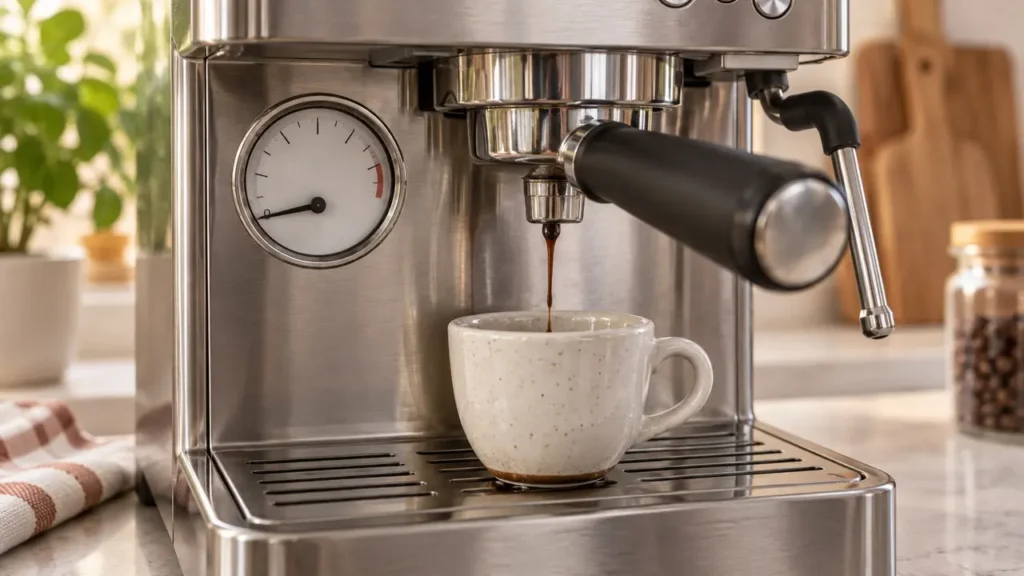
If the pressure-gauge needle stays at zero, do not assume the gauge is broken. A fast, pale shot usually means the coffee puck is not creating enough resistance. A gauge fault becomes more likely when espresso extracts normally but the needle never moves, or when the needle remains stuck away from zero after the machine has cooled.
Quick answer
Run one controlled espresso test with fresh beans, the correct basket, a measured dose and a consistent tamp. If the shot gushes in under about 20 seconds and the needle stays low, correct the grind and dose first. If the shot takes roughly 25–35 seconds, tastes balanced and has normal flow while the gauge remains motionless, stop changing the coffee: the gauge, its connection or an internal pressure-sensing path may need professional service.
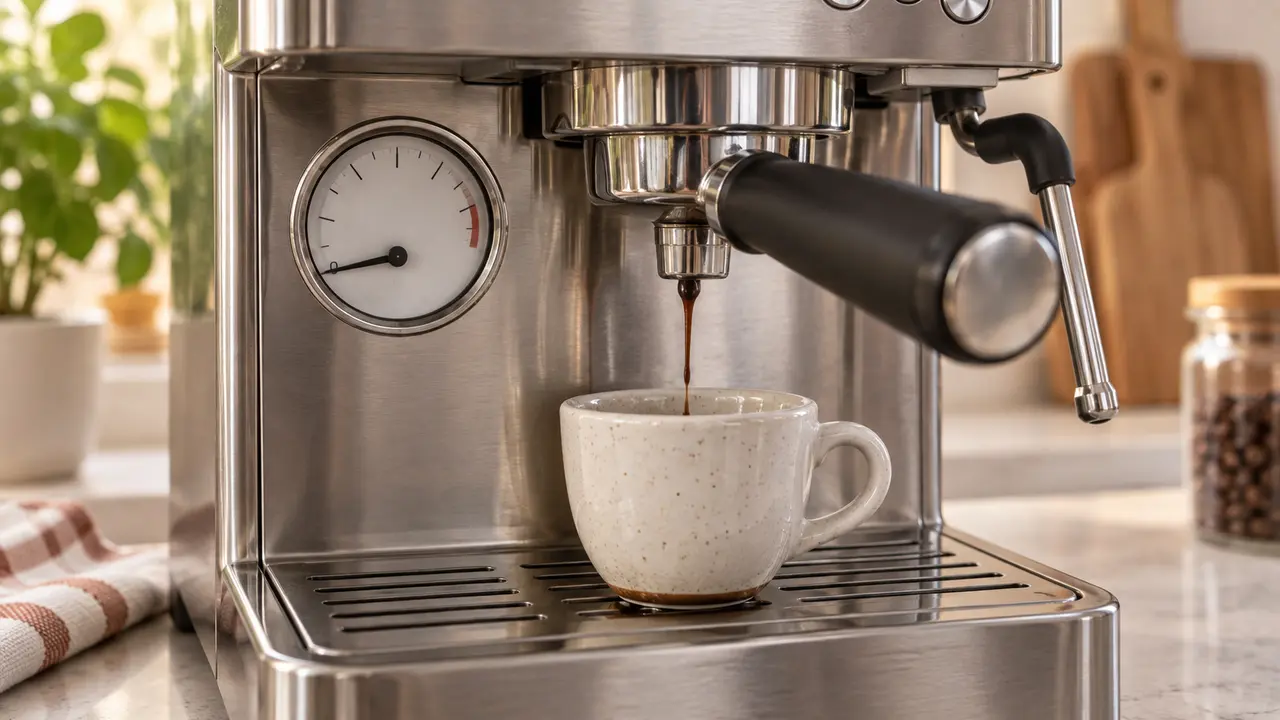
What the Barista Express gauge should do
This guide applies to the Breville Barista Express BES870/BES870XL. Breville describes the dial as an espresso extraction pressure gauge. At the beginning of a shot, the needle should sit in the low-pressure pre-infusion area; it should then rise as the puck creates resistance. During a properly dialed-in extraction, Breville expects the needle in the solid gray espresso range.
A low reading during the first seconds is therefore normal. The gauge is meaningful during an espresso extraction, not while dispensing hot water, steaming milk or running water through an empty basket. Judge the needle together with shot time, flow, crema and taste.
Gauge problem or low-pressure problem?
| What you see | Most likely direction | First check |
|---|---|---|
| Needle stays near zero and espresso gushes | Under-extraction, not a failed gauge | Finer grind, adequate dose, level tamp |
| Needle stays low and the cup is weak or watery | Puck offers too little resistance | Fresh beans and correct filter basket |
| Needle does not move and no water reaches the group | Water-delivery or scale problem | Tank seating, group-head flow and descaling history |
| Needle does not move but the shot is normal | Gauge or pressure-sensing fault is possible | Repeat one controlled test, then arrange service |
| Needle stays above zero when the machine is off and cool | Gauge mechanism may be sticking | Do not open the case; contact support |
Safe diagnosis in six steps
1. Test during a real espresso shot
Warm the machine, insert a prepared portafilter and start a shot. An empty basket creates very little resistance, so a stationary needle during an empty-water flush does not prove the pressure gauge is faulty.
2. Confirm the basket matches the coffee
Use a Single Wall basket with freshly ground whole beans. Breville supplies Dual Wall baskets for pre-ground coffee. A mismatched basket changes resistance and can make the gauge test misleading. Check that the basket is fully seated and its holes are clear.
3. Build a repeatable puck
For the supplied 2 CUP basket, the official manual gives an approximate dose of 15–18 g. Distribute the grounds evenly, tamp level and use consistent force. The goal is repeatability; pressing harder is not a reliable substitute for correcting a coarse grind or low dose.
4. Time the extraction
Breville’s extraction guide describes balanced flow as beginning after roughly 4–7 seconds and completing in about 25–35 seconds. A shot that starts within 1–3 seconds, runs like water and finishes in under 20 seconds is under-extracted. If that matches your cup, follow our Barista Express low-pressure guide before blaming the dial.
5. Check water delivery separately
Remove the portafilter and run a short group-head flush. Normal water flow tells you the machine can move water, although it does not test extraction pressure. Weak or absent flow points toward an empty or poorly seated tank, a blocked path or scale. Follow the Barista Express descaling guide if maintenance is due.
6. Repeat only one controlled shot
Change one variable at a time. If the first shot was fast, move the grind slightly finer, purge a small amount from the grinder and repeat with the same coffee weight. Our grinder-settings guide explains how to dial in without losing track of the variables.
Fixes you can safely try
- Use fresh beans. Stale coffee produces less resistance and crema even when the dial number has not changed.
- Move the grind finer in small steps. Purge retained grounds after a change so the test reflects the new setting.
- Correct an under-filled basket. Dose consistently and use the Razor tool supplied with the machine if appropriate.
- Clean blocked basket holes. Breville recommends using the pin on the cleaning tool; a stubborn basket can be soaked with a dissolved cleaning tablet and then rinsed thoroughly.
- Clean the group head. Coffee oils and debris can alter flow. If the CLEAN/DESCALE indicator calls for a cleaning cycle, follow the cleaning-cycle instructions.
- Descale when water flow has weakened. Scale can restrict the water path; use the model-specific procedure rather than repeatedly running acid through the machine.
When the pressure gauge itself is probably faulty
A gauge fault is more plausible after the coffee variables and water flow have been ruled out. Strong indicators include:
- The needle never moves across several properly prepared shots, yet shot time, flow and taste are normal.
- The needle is frozen above zero when the machine is switched off, unplugged and completely cool.
- The needle moves erratically without matching obvious changes in flow.
- The behavior began suddenly after an impact, transport or an internal repair.
The gauge is connected to the machine’s pressurized water system. Replacing it or clearing an internal sensing line requires opening the appliance and working near hot, pressurized and electrical components. Breville’s manual directs maintenance beyond routine cleaning to Consumer Support. Do not remove the case solely to test the gauge.
What not to do
- Do not grind progressively finer when the shot has already slowed to drips; that moves the machine toward over-extraction.
- Do not overfill the basket or force the portafilter into the group head.
- Do not remove the portafilter while brewing; the machine is under pressure.
- Do not use a gauge reading alone as proof that the pump is bad.
- Do not open internal pressure lines unless you are qualified to service espresso machines.
Frequently asked questions
Why does my Barista Express pressure gauge stay at zero?
The most common reason is insufficient puck resistance: a coarse grind, too little coffee, a light or uneven tamp, stale beans or the wrong basket. If espresso extracts normally while the needle remains at zero, the gauge system may need service.
Should the gauge move without coffee in the basket?
Not necessarily. With no coffee puck, water can flow with little resistance. Diagnose the gauge during a repeatable espresso extraction, while using an empty-portafilter flush only to check that water reaches the group head.
Can descaling fix a pressure gauge that is not moving?
Descaling may help when scale is restricting water flow, but it will not repair a mechanically failed dial. Descale only with the correct procedure and judge the result by both group-head flow and espresso behavior.
Is a low gauge reading always a machine fault?
No. Low-pressure pre-infusion is intentional, and most low readings during the rest of a fast shot come from grind, dose or tamp. Diagnose extraction before considering internal parts.
Official references
- Breville Barista Express BES870XL instruction manual — pressure-gauge zones, extraction guide, care and troubleshooting.
- Breville Barista Express product page — current model overview and specifications.
Information checked against Breville’s U.S. documentation on September 12, 2026. Model revisions and regional accessories can differ.