Quick answer: Philips 3200 LatteGo milk frother not working? Start with what happens in the cup. If no milk comes out, check that the detachable LatteGo is properly assembled and attached, contains enough milk for the selected drink, and has no dried residue between its two parts. If milk comes out but makes little foam, test with cold refrigerated milk at the drink’s marked level; milk type also changes the result. If milk escapes from the bottom of the container, check its transport clip, lower joint and cleanliness. Stop and contact Philips if the appropriate checks do not solve the symptom.
This article covers the detachable two-part LatteGo on compatible Philips 3200 models, such as the EP3246/74. Find the full number on your machine and use the matching manual. The cover is an illustrative generic machine and container. LatteGo has two parts without a milk tube; advice for a classic steam wand or a carafe with hoses should not be applied to it.
Which symptom do you have?
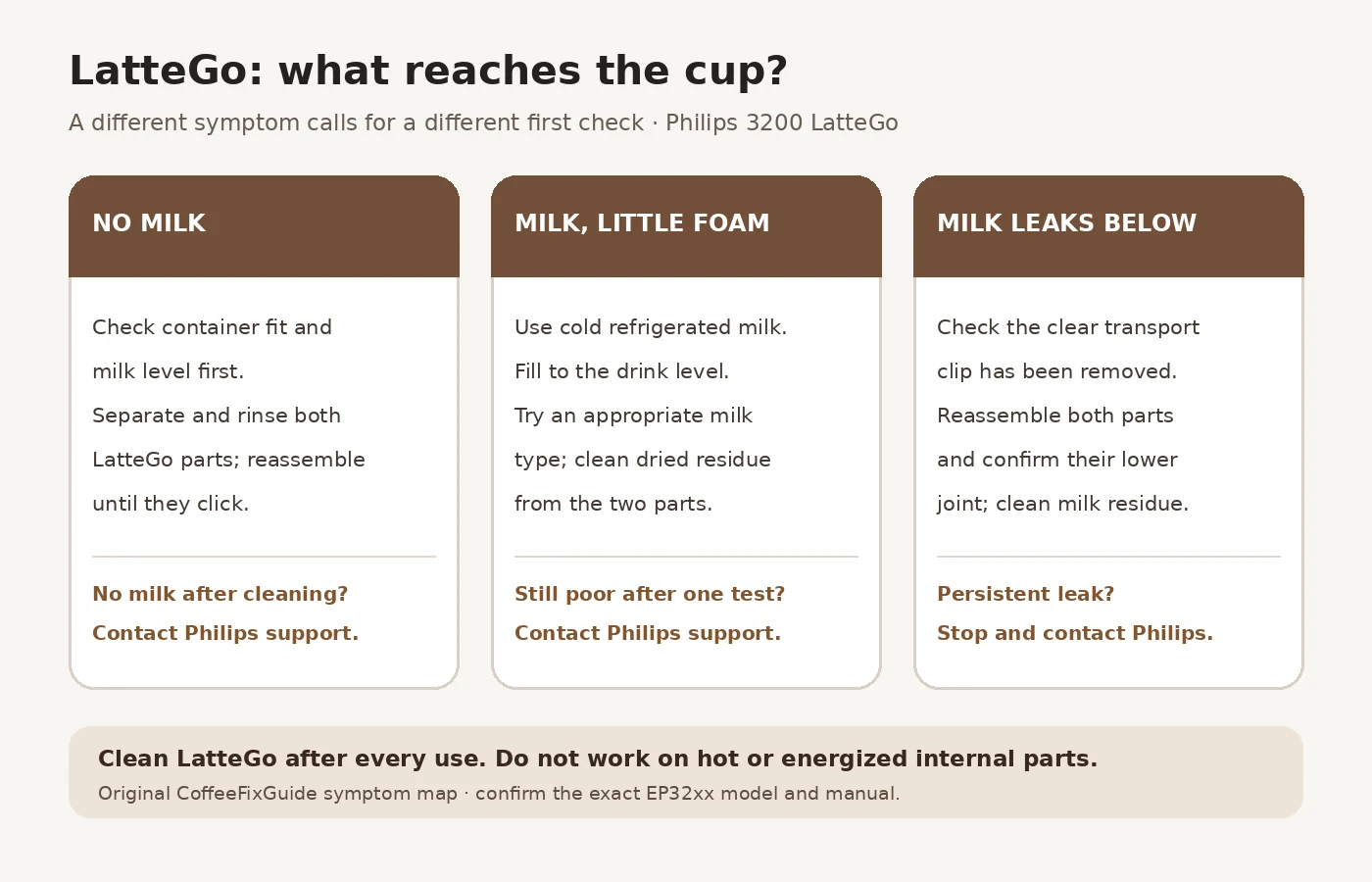
| Observation | First owner check | Do next |
|---|---|---|
| No milk dispensed | Check the selected milk drink, container level and seating; clean and reassemble the two parts. | If no milk after a normal test, contact Philips. |
| Milk dispenses, but foam is thin | Use cold refrigerated milk, a sufficient fill level and a suitable milk type. | Clean dried residue; contact Philips if the change does not help. |
| Milk leaks from below LatteGo | Remove the clear transport clip if present; join both parts until they click and clean residue. | If it still leaks, contact Philips. Keep the area dry. |
Stop point: If liquid reaches the plug or outlet, or you see smoke, damaged wiring or a tripped circuit, do not start another milk cycle. Switch off and unplug only from a dry, safely reachable outlet; otherwise isolate the supply safely and seek qualified assistance. Do not open the outer casing or test a hot internal steam line.
What you need
- The detachable LatteGo container, clean water and a soft cloth.
- Fresh, cold refrigerated milk for one controlled comparison.
- Your full EP32xx model code and regional support/manual page.
No screwdriver or special replacement part is needed for the following checks.
1. No milk comes out at all
Start by confirming that you selected a milk recipe and the container has enough milk for that drink. Do not infer a failed pump from a dry cup; the container can be incompletely attached or have dried milk in its joint.
- Stop the cycle and let the milk outlet cool. Remove LatteGo from the machine using the normal attachment method for your model.
- Separate its two parts. Rinse them thoroughly under tap water, paying attention to dried milk where the parts meet. Philips recommends rinsing LatteGo after each use; its LatteGo parts can also be cleaned in the dishwasher according to the manual.
- Reassemble the two parts until they click together. Check their fit at the bottom and attach the container securely to the machine. The official Philips LatteGo assembly guide shows the joint.
- Fill to the level for your chosen milk drink and run one normal test. Observe whether milk enters the cup, whether the outlet sputters, and whether liquid collects under the container.
If the machine also fails to dispense hot water, follow the separate Philips 3200 no-water diagnostic for the water path. If hot water works but no milk appears after correct LatteGo cleaning and seating, stop owner checks and contact Philips with the exact model number and symptom. That comparison helps describe the fault but does not identify an internal valve or steam component.
2. Milk comes out, but the foam is thin
Here the milk system is moving milk. Philips’ foam guidance starts with three controllable variables: temperature, amount and type of milk. Changing all three at once hides what mattered, so use a single small test.
- Rinse and reassemble the two parts, then use milk directly from the refrigerator. Philips says warmer milk can affect frothing quality.
- Use enough milk for the selected recipe. If the level is too low, the system can draw air early and the foam can suffer.
- Try a milk suitable for foaming. Philips lists semi-skimmed, full-fat and lactose-free cow’s milk and recommends checking whether a plant-based drink is formulated for frothing, often labelled “Barista” or “Professional.” Foam will vary by product.
- Make one milk drink and compare it with the prior result. If the quality remains poor despite clean parts, adequate cold milk and another suitable milk type, contact support.
Do not buy a new LatteGo assembly just because one carton of milk foams differently. A weak foam texture is not enough to diagnose a failed internal part.
3. Milk leaks out of the bottom of LatteGo
This is a container leak, not the same as clear water beneath the machine. Philips’ instructions say to remove the transparent transport clip from a new LatteGo, hook the black spout over the container, press the two parts together until a click and check the lower joint. Milk residue trapped between the parts can also cause leakage. Separate and rinse both parts, then reassemble using the official assembly illustration.
If the container still leaks after a clean reassembly, contact Philips; do not tape the joint or use the leaking container near electrical areas. If the puddle is instead clear water at the tank side, see our water leak-location guide.
Prevent the problem returning
Rinse LatteGo’s two parts under tap water after each use, or use the dishwasher when permitted for your exact LatteGo model. Let the parts dry and reassemble them correctly before the next milk drink. Do not confuse the two-part LatteGo with Philips’ other milk carafes: Philips says those other systems are not dishwasher safe. Keep the container’s mating edges free of dried milk rather than pushing a sharp tool into any opening.
Repair and parts
Owner checks cover cleaning, assembly, milk level and milk choice. A persistent no-milk result, repeated leak after proper assembly, or new noise from inside the machine needs Philips support or a qualified service diagnosis. No honest failure percentage can be assigned from these symptoms alone. Ask for the diagnosis and compatible part number for the full EP model before ordering an accessory. If a repair quote is substantial, compare it with replacement using our repair vs replace calculator.
FAQ
Why is there no foam with oat milk?
Plant-based drinks produce different foam. Philips recommends checking for a version formulated for frothing; test it cold with enough liquid in a clean LatteGo.
Does LatteGo have a tube I should clean?
The detachable two-part LatteGo is designed without a milk tube. Clean its two parts and joint following the model manual; do not follow instructions for a separate tube-based carafe.
Can LatteGo go in a dishwasher?
Philips says LatteGo’s two parts can be washed in the dishwasher, while other milk systems may not be. Confirm the manual for the exact accessory and regional model.
Should I descale to fix thin milk foam?
First try the manufacturer-supported cold-milk, fill-level and cleaning checks. Use descaling instructions when the machine calls for that maintenance; a foam symptom alone does not identify scale.
Official references: Philips: milk not frothing well; Philips: cleaning and maintenance; Philips: LatteGo leaking below (checked September 27, 2026). For other machine symptoms, return to the Philips 3200 troubleshooting hub. CoffeeFixGuide is independent and not affiliated with Philips.